Dar Si Hmad for Development, Education and Culture is an independent nonprofit organization founded in 2010 promoting local culture and sustainable initiatives through education and the integration of scientific ingenuity in Southwest Morocco. We operate North Africa's largest fog harvesting project, providing villages with access to potable water. Our Water School and Girls' E-Learning Programs build capacity in the Anti-Atlas Mountains. Through our Ethnographic Field School, researchers and students engage with local communities in Agadir, Sidi Ifni, and the rural Aït Baamrane region for meaningful cross-cultural exchange.

Showing posts with label Travel Abroad. Show all posts

Friday, July 26, 2019

Learning Across Continents: Climate Change policy, Coffee and Crepes for summer 2019

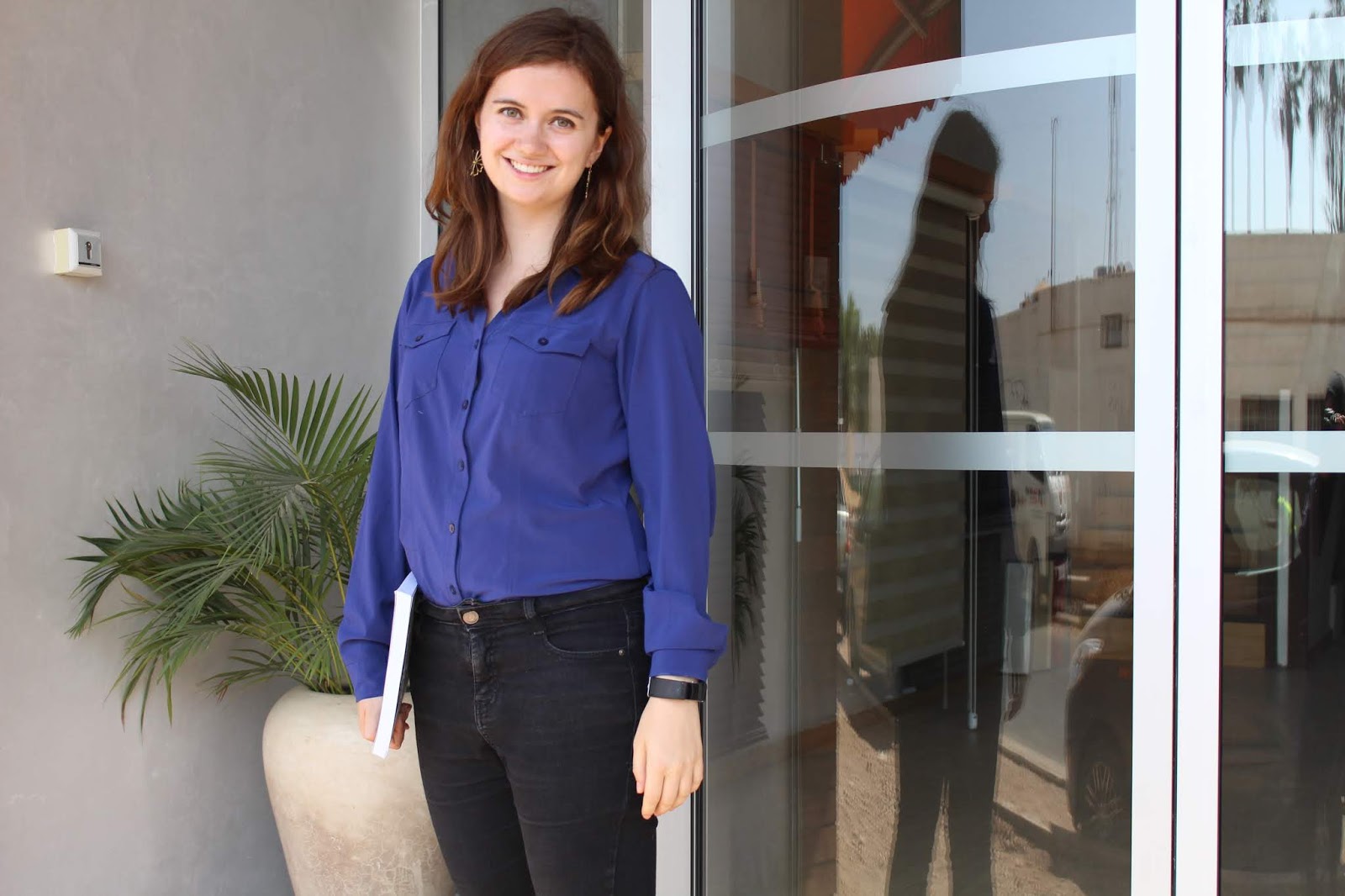
Written by Jayme Beaseley
Jayme is a second year PhD student in the department of Political Science at Clark Atlanta University in Atlanta, Georgia. She is affiliated with Dar Si Hmad through Women Global Empowerment Initiative and this is her second year working with both organizations as a graduate student.  
When I was asked to return to Morocco on behalf of Women’s Global Empowerment Initiative (WGEI) this summer I was elated. I had the pleasure of serving as a student mentor for the women who attended WGEI and Dar Si Hmad’s program last year. The experience was life changing in that I was able to learn about the Moroccan culture, society and politics. My role last year also enabled me to make lasting connections with WGEI members and Dar Si Hmad staff and participants.
My role this year was a little different. I came back to beautiful Morocco to explore the socio-political dynamics surrounding water distribution. As a second year doctoral student in the Department of Political Science at Clark Atlanta University in Atlanta Georgia, my experience last year has narrowed my research interest toward issues in political ecology. This summer during my time at Dar Si Hmad, I’ve spent the last 5 weeks searching and reading articles to gain a better understanding of the ways in which the Moroccan government, Nongovernmental Organizations (NGOs) and private entities work in tandem to manage and distribute water to Moroccan citizens. My hopes are to continue this research for my dissertation.
It wasn’t all work while I was here this time, Kenia and I visited one of the most popular tourist destinations in the world- Marrakech. This trip was nothing short of exciting. We were able to experience a night in a traditional riad in the heart of the Médina. We visited Jardin Majorelle. Restored by French designer Yves-Saint-Laurent, the garden was filled with vibrant hues and exotic plants from around the world. We next visited the Bahia Palace which was built in the 19th century and considered one of Morocco’s most visited attractions. The palace had intricate colors and patterns spread offer 2 acres of land. It was filled with mini gardens and secret rooms. Lastly, we walked around the Koutoubia Mosque located in the southwest of the Médina. It is the largest mosque in Marrakech. It is decorated with large intricately curved windows that allow for ample sunlight to shine inside. We also bought street food and got lost in the labyrinth of souks that were filled with raw leather bags, precious metals and stunning hand made shoes. Our time in Marrakech was short but very worth it.
My time here in Morocco this summer has made me realize that there is so much more to learn in the world that has to be experienced outside of a formal setting. We learn the real lessons interacting with different people from different cultures and beliefs. This experience makes us grow and become better people. Although I came here for academic reasons, I feel like I will leave with a better understanding of why it is important to continue to work on being a world citizen. My summer here in Morocco and working with Dar Si Hmad has made me more confident in my research abilities and sharpened my analytical skills. I am so thankful for this opportunity. Thank you to Dar Si Hmad and WGEI! 

Friday, July 19, 2019

Learning Across Continents: Reflections on a moroccan summer

Written by the EFS Student Kenia Hale
 Kenia Hale is an American student from Yale University who participated in WEGI’s 3 week intensive on race, gender an environmental studies. Kenia is receiving assistance on her academic research from DSH staff and has been taking daily intensive Darija lessons in the organization.

When I arrived in Morocco 5 weeks ago, I wasn’t sure what to expect. I knew Morocco was on the African continent, and had taken 1.5 years of modern standard Arabic, but I knew nothing about the culture or history of the place. In my time with Dar Si Hmad and the Women’s Global Empowerment Initiative (WEGI) I’ve learned so much more about the world, and have learned more about myself in the process.

In my first three weeks here, I participated in an intensive program where we learned about race, gender, social justice, and environmental justice in Morocco directed by Dar Si Hmad. Each day comprised of a Darija (Moroccan Arabic) lesson, a class on a specific subject, and daily excursions that provided context for the issues we discussed in the classroom. We learned about Amazigh history, Sub-Saharan Migration in Morocco, Gnawa culture, and much more! In just three weeks I found myself rethinking my perceptions of race, gender, and culture in my daily life.
As a dark skinned Black woman, my race and gender color defined my experiences at home and abroad. Morocco is, as described by our program coordinator, an incredibly “plural” place, and we are constantly surrounded by people of every color. My friends and I were told that any of us could pass as Moroccan, which I understand to be true when looking around the market, the beach, etc. This being the case though, it was often our lighter-skinned group members that are told that they “look Moroccan” by shop owners and others we interact with. I’ve been asked if I’m from Jamaica, Cameroon, Côte d'Ivoire, and many other sub-Saharan countries, and have been told that I “look too black to be American.” These experiences have complicated my understandings of “Blackness” at home and abroad, and challenged many of my preconceptions of who can be considered “African.”
Kenia and her fellows taking the lessons directed by Dar Si Hmad
Morocco is so beautiful, and I’ve experienced so many different parts of it in my time here. In Marrakesh, I got to visit the bustling medina, shop in the huge souks, and visit popular landmarks like Jemaa el-fnaa, Jardin Marjorelle, and Bahia Palace. In Sidi Ifni, we relaxed in our town house and got to visit Dar Si Hmad’s fog project, which is definitely a sight to see. That day in particular it was really cloudy and misty, and it was really cool to see the fog nets in action! We traveled to Aourir where I saw the biggest waves and bluest ocean I’d ever seen in my life. We visited a women-led Argan Collective, where we learned about the argan business and tried cracking Argan nuts. I’ve spent most of my time in lovely Agadir, a city on the South coast of the country, where I’ve been living with my incredibly kind and welcoming host family. They’ve provided me a home away from home, and my host mom makes the best avocado smoothies I’ve ever had!
In Dar Si Hmad's fog proect Site

I’ll be here for a total of 8-weeks, and have been doing my own independent research on development and technology with the help of Dr.Bargach and the DHS staff, alongside a PhD candidate working on research for her dissertation. I’ve also been continuing my daily intensive Darija lessons, and I can feel myself learning so much every day. I can now successfully hail a taxi, ask about prices in the Souk, order food at a restaurant or ask my host mom to take us to the beach. I know colors, numbers, how to tell time and ask directions, and much more. The constant immersion in the language is helping me pick up the language so much more quickly than I did at school!
This experience has both helped me realize how much I already know and how much I have left to learn about the world and myself. I’ve met lifelong friends and can feel myself growing into a more worldly person every day. I’m incredibly inspired by the people I meet and the work that DHS is doing in the community, and I’m so glad I took this leap and traveled this summer!

Friday, July 12, 2019

Learning Across Continents: Learning across one continent


Written by DSH intern Walid Zarrad:

Walid Zarrad is a Tunisian intern in Dar Si Hmad who has demonstrated strong organizational skills in managing the organization's inventory, both in Agadir and in Sidi Ifni, during his stay in Morocco.


While traveling to a new culture, you learn something new every second. It might sound cliché but from the moment you arrive, lessons start flooding in; and these lessons include everything from culture studies to linguistics.
As a Tunisian, I thought traveling to a country as close as Morocco would mean avoiding the culture school. I quickly understood that instead of learning new things, I would be learning new things and comparing them to what I’m familiar with. In other words, the subtle yet omnipresent differences turned my trip into a game of “let’s find out how, why, and to what extend this is different!” And I loved it.
During my month in Agadir, I learned to turn into a sponge whenever I entered a drugstore or café. Hell, even walking down the street I wanted to grasp as much information as possible. What I used to believe was extra mental labor turned into a hobby.
And what better place to practice this hobby than Dar Si Hmad? I walk in and see hard-working, friendly, and diverse staff members mixing their different backgrounds to come up with outstanding projects. I walk in and meet student researches who are happy to teach me and learn from me. I walk in and learn how to use the anthropology that fascinates me to help communities in need.


This trip confirmed to me that every culture is an iceberg with a small part the world sees and a huge part you have to dive in the waters to find out about. And nothing is more fun and challenging than diving in head first. If you’re lucky enough, the swim will turn into a thousand questions. I was constantly thinking about all the factors that could have influenced a specific difference between Moroccans and Tunisians: is it the different decolonization processes? Is it the different approaches to arabization and westernization? Or is it just different geographies?


I am writing this from the top of Mount Boutmezguida, next to Dar Si Hmad’s Cloudfishers. Although I‘m 1225 culture meters high, I can see that higher mountains are ahead of me. I can’t wait.

Wednesday, October 10, 2018

Learning Across Continents: America sharing knowledge with Africa


Written by DSH Fellow Katie Tyler

Katie is a recent graduate from Princeton and a fellow of Labouisse Fellowship. She is working with Dar Si Hmad on the capacity building project for NGO's .

Dar Si Hmad Intern Katie Tyler
A little more than five years ago, I found out that I had received the opportunity of a lifetime. Thanks to the National Security Language Initiative for Youth (NSLI-Y), I had been awarded a scholarship to study Arabic in Marrakech. I had never lived outside of the U.S. before, and I was excited for the chance to be immersed in studying a foreign language. At the end of my six-week experience, I was able to speak Modern Standard Arabic a little better, but I wanted to continue improving my language skills.
When I entered college the following year, I knew that I wanted to continue studying Arabic and different cultures of the Middle East and North Africa. Becoming a Near Eastern Studies (more commonly known as Middle Eastern Studies) major at Princeton University was an obvious choice for my course of study.
During my third year of college, I spent a year writing an independent research paper the reconstruction of Agadir after the 1960 earthquake. Reading books about Moroccan history and newspaper archives from Agadir reminded me of how much I missed living in Morocco. Based on my experiences interning at a youth homeless shelter in Newark, New Jersey, I also knew that I wanted to gain more experience in working with nonprofit organizations that fight poverty. 
A mosque in Agadir (Taken by Katie)
I was lucky enough to attend a university that is able to support my career aspirations to work in sustainable development abroad. I am able to work in Agadir with Dar Si Hmad thanks to the Labouisse Fellowship, named after Princeton alum Henry R. Labouisse, who was most notably awarded a Nobel Peace Prize for his work as the president of UNICEF. The Labouisse Fellowship provides graduating Princeton seniors with the funding to pursue a yearlong project in international development in partnership with a local nonprofit organization.
Henry R. Labouisse
I reached out to the former NSLI-Y program coordinator for advice on finding a partnership with a Moroccan organization, and she enthusiastically recommended Dar Si Hmad. When I researched Dar Si Hmad’s work to provide water to rural communities and empower young people, I did not hesitate to get in touch. I worked with Jamila Bargarch, Dar Si Hmad’s Executive Director, and Maisie Breit, the former EFS Manager, to devise a plan for how I would use the Labouisse Fellowship to support some of the organization’s new projects during my time in Morocco.  After spending so many hours reading and writing about Agadir it felt surreal to be moving to the city for an entire year in late June.

One of the main projects that I am working on here at Dar Si Hmad is the new capacity building project. I am working closely with Jamila and Hafida Mazoud, DSH’s Communications Officer, to design and implement an eight-month-long training series for a group of small associations in Agadir, Tiznit and Sidi Ifni regions. Our beneficiaries are working with a diverse range of issues, such as literacy in refugee communities, women’s empowerment through income-generating initiatives, the preservation of cultural manuscripts, and the use of solar energy in villages. In the training, we will cover topics such as administration, financial management, and program management.
Our Intern Katie and
Communication officer Hafida
The goal of this project is to equip local leaders with stronger management skills so that they can expand their organizations’ reach and social impact more effectively. Each participant will develop and implement a new project or campaign by the program’s conclusion in June. We intend to equip participants with the tools to materialize their visions to change their communities. We are also committed to incorporating principles of environmental sustainability and gender inclusion throughout the project. I am especially hopeful that this capacity building workshop will continue to benefit communities in southern Morocco long after my fellowship concludes.      
In addition to my work on the capacity building project, I am assisting Jamila with research on Dar Si Hmad’s ongoing fog project. Outside of the office, I enjoy trying delicious new pastries from the bakeries around Agadir and going to BodyPump classes. I am improving my Darija, and I have recently started learning Tachelhit with Lahcen, a teacher who partners with Dar Si Hmad. I wrote my undergraduate thesis about how Tuareg communities attained mass literacy in the Tifinagh script, so I always try to read the Tachelhit signs written in the Tifinagh script around the city. 
If you see me in the DSH office, I am always excited to hear new recommendations on books about Morocco, as I am trying to learn as much as I can during my stay here! 
 Katie at the office

Wednesday, September 26, 2018

Learning Across Continents: My first travel abroad experience


Written by DSH intern Ambar Khawaja:

Ambar Khawaja is an American intern on a gap year of service through UNC’s Global Gap Year Fellowship. She is working with us on an upcoming project that we will reveal more information about in the future on our blog. 


Traveling means a different thing to each person who experiences it. When I was preparing to come to Morocco, I had no idea what it would mean to me. I listened to stories of other people’s travels overseas with wide eyes, peppering them with questions with the intent to satisfy what I believed I had not yet experienced. 
I spent hours scrolling through my social media, seeing beautiful, vibrant images of adventures and locations in different countries. These images fed into the preconceived notion I had of traveling and living abroad, which I have now learned is highly misrepresentative of one’s true experience. Life here is not constantly the “picture perfect” snapshot you imagine when moving to a foreign country; Instead, it resembles life in general, with its ups and downs, but with tremendous space to grow.
There are many facets of my identity that have helped me blend into Agadir. As an 18-year-old, Muslim, Pakistani-American woman, I physically do not stand out in the crowd. Basic words, like “salam”, “shukrun”, and “inshallah” come easily to me because of my second language: Urdu. At a glance, I am just like everyone else around me, but ask me a question in Darija and you will be met with a blank stare. 
The first thing I learned how to say when I arrived was “ana Pakistaniya” so that I could communicate to the confused Moroccans around me that I myself was not Moroccan. This physical similarity with those surrounding me has given me some privileges, like not being overcharged by a taxi or not being stared at like a tourist while walking down the street. Conversely, it has made my experience traveling as an American much more complex than I expected. Because of this situation, however, I have learned an absurd amount about myself and my skills, or lack thereof in some cases.
On the surface, I fit in, but the nagging knowledge that I don’t speak the language or know the culture as well lends itself to a lot of cognitive dissonance. I definitely feel embarrassed when the person I am out with has to explain that I speak English, however, I wonder if this sense of self-consciousness is because my looks don’t match up with my language. I ask myself “how different would I feel if I matched the stereotypical image of a white American”, and “how would the privilege of looking like what my nationality is ‘supposed’ to look like change my interactions with people”. 
This photo was taken by Ambar

I have observed that it is more likely for local people to change the way they approach a conversation with this stereotypical image of an American because they feel the need to adapt to them, rather than the foreigner to adapt to the culture they are in. This is the privilege of speaking English. However, I appreciate my physical appearance making it more difficult for Moroccans to pinpoint where I am from, because I am then placed into more situations where I must adapt to this new language environment. Sometimes I must resort to speaking in English, but this is because I understand the limits I have when trying to communicate in French or Darija.
The language barrier has been the single most difficult experience for me thus far. When I first arrived, I found myself speaking a mix of English, Urdu, and Spanish, since these languages lead to conversations in my world. Pointing, hand gestures, and shaking my head “no” have proved to be an effective way of communication for me when my interlocutor doesn’t understand English. While humorous on many levels, it has also provided me with the opportunity to learn non-verbal communication skills and living with a host family has given me the chance to sharpen them. 

My host mom, in particular, speaks very little English, yet we have formed a beautiful bond in the short amount of time I have spent here. Helping out in the kitchen, watching the sunset together in awe and admiration, having the same faith, and sharing photos of each others’ lives has created a relationship between us that couldn’t have been created by words, since words sometimes get in the way of moments. This is not to say that language is not beneficial since our relationship is finding new joys in language exchange, with me starting to learn Darija and teaching my host mom words in English. Learning the language of the place I am living in will also remove the barriers I have in trying to interact with locals and will prevent my overarching privilege of speaking English from interfering in conversations. Lucky for me though, I do not face these problems in my workplace.


  I have found a lot of purpose in my work here as an intern. Being the youngest person in the office has helped me fine-tune some of my skills since I am constantly surrounded with more experienced coworkers offering me constructive criticism to help improve and add to what I already know. It’s an interesting experience to learn more about my capabilities by doing things I have not done before, like tutoring English and planning programs for high schoolers. 
Being in the presence of these amazing people has helped me adjust much faster to living here than I would have if I had to figure out everything alone. Because I have people to show me their favorite places in the city and teach me how to order food or buy something at the “hanout”, the transition has been much smoother. I have been given a solid foundation on which to venture out alone on.
A picture of the souk "taken by Ambar"
Traveling solo for the first time has enforced the concept that I am accountable for myself. There is no external reason that I can’t go out and try something new, face a fear, or take a risk. All of my choices are in my own hands, and that is a very liberating feeling to have because it opens up my life to a lot of personal growth. Now is the perfect time for me absorb everything around me.