Dar Si Hmad for Development, Education and Culture is an independent nonprofit organization founded in 2010 promoting local culture and sustainable initiatives through education and the integration of scientific ingenuity in Southwest Morocco. We operate North Africa's largest fog harvesting project, providing villages with access to potable water. Our Water School and Girls' E-Learning Programs build capacity in the Anti-Atlas Mountains. Through our Ethnographic Field School, researchers and students engage with local communities in Agadir, Sidi Ifni, and the rural Aït Baamrane region for meaningful cross-cultural exchange.

Showing posts with label southwest Morocco. Show all posts

Tuesday, April 21, 2020

Water in the age of coronavirus


In the age of a pandemic, there is one piece of advice repeated again and again by health and government officials: wash your hands. Specifically, wash your hands for 20 seconds with clean water and soap.

But in Morocco – a country where water resources have fallen by 71% since 1980 – access to clean water and sanitation can be challenging, especially for those in the mountains and rural areas. It is during unprecedented times like these that we are reminded of the importance of Dar Si Hmad’s fog harvesting project: a project that captures fog and turns it into clean water for Morocco’s most vulnerable.

For residents in the Anti-Atlas mountains, close to Sidi Ifni, many have to make hours-long trek to get to and from their nearest water source. This trek is most often made by women, who are considered as providers within the household, who can only bring back so much water after a long trek. Access to clean water for those in these regions seems to be, unfortunately, a luxury.

Clean water, however, is a human right. It is a human right that can save lives during the time of a global pandemic. After all, washing your hands and limiting activity outside the home are powerful measures to prevent the contraction and/or spread of coronavirus. But practicing these preventative measures is not easy for those who must travel hours for water. In Morocco, a stay-at-home order was put in place preventing all non-essential travel outside of the house.

Despite temporarily closing our offices in Agadir, we at Dar Si Hmad are carrying on our work to make sure some of Morocco’s vulnerable communities continue having access to clean water. Most importantly, we are currently in the preparation phase for building new CoudFishers – or, fog collectors – in Taloust, an area adjacent to the Boutmezguida fog collection site. Once this construction is done, Dar Si Hmad will be able to provide 32 tons of water a day to 12 additional rural villages of Southwest Morocco.

But the work does stop here, the local communities do come together to support one another in mutual aid. That is why Dar Si Hmad has donated the support proceedings of fog-water for the entire month of March to the beneficiaries.  We continue the tradition of Si Hmad Derhem who, in dire times of need, showed amazing support for these communities. 

Even after the age of coronavirus, however, there will still be work to do. The effects of climate change – which, in Morocco, include tougher, longer and harder droughts – will cause more and more people to risk losing their access to clean water as well as their source of livelihood. Additionally, experts warn that climate change may exacerbate the frequency and spread of diseases like the coronavirus. With so much uncertainty and risk, one thing that is clear is the need for projects like Dar Si Hmad’s fog harvesting project that provide access to clean water. 


Written by: Gari De Ramos, Dar Si Hmad Intern

Saturday, February 29, 2020

The Capacity Building Program Beneficiaries: FIKR NGO

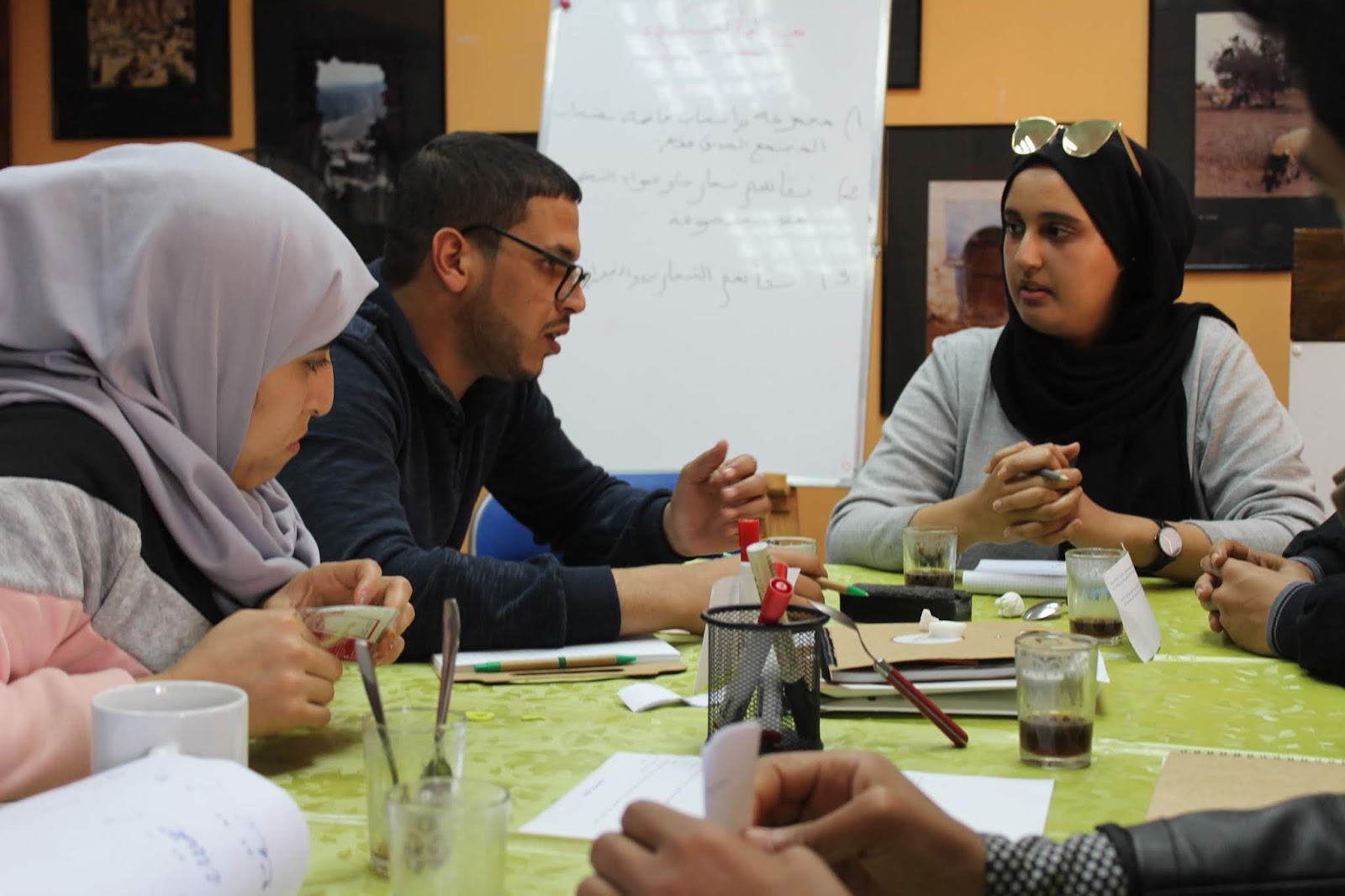
On December 28TH 2019, Dar Si Hmad organized a get- together for the organsations and association which  benefited from our Capacity Building program. This initiative provided training and guidance for NGOs in Southwest Morocco. Marouane Ijioui and Hassan Idouhan from the Ifni-based association FIKR attended the event and answered some of our questions, giving you insights on how their NGO functions
Marouane Ijioui, the president of Fikr NGO
Below is a translation of our discussion:

Q: When was your NGO founded and what is your main area of activity?

A: Fikr was founded in 2013 and it works mainly in Cultural activities.

Q: How did you learn about Dar Si Hmad’s Capacity Building Program for NGOs? And why did you apply for it?

A: We learned about it through a friend and for us, it was an opportunity since we knew that the training was meant to empower NGOs active in different fields, including culture –which was what was relevant to us.

Q: How did your organization benefit from this training?

A:  This training taught us a lot and made several concepts become very clear for us.  All this in the end helped us tremendously in becoming a very active NGO in the province of Sidi Ifni.

Q: What are your NGO’s new year’s resolutions for 2020?

A:  We aim to attain two main goals: Revitalizing the cultural scene of Sidi Ifni and empowering future leaders.

Q: Do you see any future possible collaborations working with Dar Si Hmad on a project?

A: Of course! After all, we both work within the field of Culture and in Sidi Ifni which makes a collaboration between our organizations a very likely event.

Dar Si Hmad was delighted to see  Marouane and Hassan again at this get-together – they even showed us a video summarizing all the amazing work they’ve accomplished since the Capacity Building program. 

Friday, July 12, 2019

Learning Across Continents: Learning across one continent


Written by DSH intern Walid Zarrad:

Walid Zarrad is a Tunisian intern in Dar Si Hmad who has demonstrated strong organizational skills in managing the organization's inventory, both in Agadir and in Sidi Ifni, during his stay in Morocco.


While traveling to a new culture, you learn something new every second. It might sound cliché but from the moment you arrive, lessons start flooding in; and these lessons include everything from culture studies to linguistics.
As a Tunisian, I thought traveling to a country as close as Morocco would mean avoiding the culture school. I quickly understood that instead of learning new things, I would be learning new things and comparing them to what I’m familiar with. In other words, the subtle yet omnipresent differences turned my trip into a game of “let’s find out how, why, and to what extend this is different!” And I loved it.
During my month in Agadir, I learned to turn into a sponge whenever I entered a drugstore or café. Hell, even walking down the street I wanted to grasp as much information as possible. What I used to believe was extra mental labor turned into a hobby.
And what better place to practice this hobby than Dar Si Hmad? I walk in and see hard-working, friendly, and diverse staff members mixing their different backgrounds to come up with outstanding projects. I walk in and meet student researches who are happy to teach me and learn from me. I walk in and learn how to use the anthropology that fascinates me to help communities in need.


This trip confirmed to me that every culture is an iceberg with a small part the world sees and a huge part you have to dive in the waters to find out about. And nothing is more fun and challenging than diving in head first. If you’re lucky enough, the swim will turn into a thousand questions. I was constantly thinking about all the factors that could have influenced a specific difference between Moroccans and Tunisians: is it the different decolonization processes? Is it the different approaches to arabization and westernization? Or is it just different geographies?


I am writing this from the top of Mount Boutmezguida, next to Dar Si Hmad’s Cloudfishers. Although I‘m 1225 culture meters high, I can see that higher mountains are ahead of me. I can’t wait.

Friday, June 28, 2019

Capacity Building Program Closing Ceremony

Written by DSH fellow Katie Tyler
After eight months of lots of hard work, learning, relationship building, and fun, the Capacity Building Project has come to a conclusion!
This past Saturday we met with our participants and two of our trainers for the Capacity Building Closing Ceremony. Each pair of participants from the same NGO presented on their organization’s work to launch a new project based on the knowledge they have gained throughout the training workshops. Our participants have been hard at work during the past six weeks to turn their visions into concrete plans for change.
We were incredibly impressed by their innovative ideas as well as the amount they have learned over the course of the past eight months. The participants used tactics such as SWOT analyses, SMART goals, problem and solution trees, and GANTT charts to analyze their projects’ potential impacts and make thoughtful action plans. We expect to see great things from each participant in the coming months, as well as throughout the duration of their long and successful careers! 
After the participants finished sharing their plans for new projects, two of our trainers gave their feedback on the presentations as well as their final thoughts on the success of the training workshop series.  Our NGO president, Aissa Derham, and our Executive Director, Jamila Bargach, also gave concluding remarks on the work that went into developing this program. We celebrated our achievements with a delicious lunch prepared by our cooks Aatiqa and Hadda.
However, the impact of the Capacity Building Program does not end here! We have developed a Capacity Building Training manual in Darija that covers useful information for NGOs to develop their organizations. Each participant was given extra copies to distribute among interested leaders in development across southern Morocco. We also plan to make this manual available online to those who want to learn more about building their NGO’s capacity and maximizing their organization’s impact.
Although the program has officially ended, I hope that the participants will continue to maintain their relationships with each other and with Dar Si Hmad in order to support each other in their tireless work to support their communities. Since the goal of the Capacity Building Project was not merely to deliver instructions for change but rather to equip participants with the tools to improve themselves and those around them, participants will be able to continue to draw upon their knowledge to build NGOs’ capacity. Perhaps Dar Si Hmad will launch another Capacity Building Workshop, and these participants will lead their own initiatives to build other organizations’ capacities! 

Sunday, June 2, 2019

Learning Across Continents: Let Me Tell You about the Mountains in Morocco!


Written by our former intern, Ms. Ambar Khawaja

Ambar during her stay in Morocco

Let me tell you about the mountains in Morocco. As you begin to climb them, you look up to see the sun shining through the clouds and the peaks peeking out above them. As you continue forward, you begin to find yourself in the fog. This fog can be bothersome, because you want to be able to see the top and the climb is no longer as scenic as it started out. It clouds your vision. It seems like forever until you are out of the fog, but as you keep walking you start to brim with joy and thankfulness because you can once again see clearly. You are high above everything, watching the world move along at what seems like such a slow pace in the grand scheme of things. Perspective.
I once was the girl who thought she had her life figured out:
1.    Graduate high school accomplished;
2.    Go to a good college and major in neuroscience;
3.    Get my PhD and do research on the brain;
4.    Get tenure at a university so that I can be a professor and have my own lab;
5.    Amongst all of this, travel the world
Truthfully, this was not entirely my dream. It was a mixture of the dreams of the people I’ve looked up to and it was sculpted by how society views success. I was equipped for this specific version of life and did not expect to deviate from it. I had such certainty chasing after these goals. Everyone was in awe of my drive and determination to reach the end; but it seemed like even if I did reach the end, I would never reach satisfaction. I felt empty without praise because my worth was based off of my achievements. It was no wonder that when I reached a new goal, I would either become stalled or feel like there was still something lacking. The thought that there is always someone better than me out there constantly seeped into my mind. This led to a cycle of chasing prestige, recognition, and anything else that I could use to make myself feel better about my worth. I never knew that success and despair could happen simultaneously, and that the former could cause the latter. I didn’t know how to just be.

Taken by Ambar

What do people do in the in-between of life? The in-between is what I refer to as the space that occupies the emptiness between my failures and my successes. It’s my worst mental enemy, but if handled correctly it can be my best mental friend. I would like to point out that this space that baffled me is actually just called life by most people, and that the accomplishment-hungry-me just didn’t know what living actually was yet.
While my goals and accomplishments were a large part of my life, they weren’t the only part, and I was neglecting the rest of myself. I was becoming unaware of the many other layers I contained as a person, leading me to be hollow.
At times like this, far away from home on another continent, where people speak another language and I know virtually nothing, I am sitting in my room reflecting and writing about the changes I have noticed in the month and a half I’ve spent here. Worries are less, small mistakes are forgiven easier, and I am not basing my value on achievement. Here, people do not care about what you have done as much as they care about the kind of person you are; whether you are kind and how willing you are to try and learn. Finally, in a place where I know nothing, I can learn everything without self-judgement. I do not have the pressure to always be doing something in a society that puts emphasis on busyness. What a privilege. Finally, I am learning to act in the in-between. I am emptying the pot that everyone poured their hearts and souls into and putting it in storage so that I can begin to fill my own. Each is important. One is what I came from and what I am made of, and the other is what I will become.


My community pumped me with love and purpose, so even though I didn’t expect to deviate from my original life plans, I was prepared for it. My family, mentors, teachers, and friends are only some of the people who helped inflate me so that I could learn to fill up my skin. Creating a community for myself was a conscious choice. Yes, I am uncertain about my future place in the world. My plans are changing, and I don’t know what I am meant to do. Purpose is such a heavy word that calls my name. At a time like this, I have found that my immense skill of worrying is truly no help to me, but the simple human action of breathing serves to be the best mechanism to assist me. Life has taken me this far, and the universe has created a path and given me all the signs I need to follow it along to my destination.
Every day I may find myself in the foggy place, I remember the top of the mountain I’ve always reached, regardless of my worries, confusion, and uncertainty. Faith is showing me my way, step by step. I need to take the time to pause and remember the grand scheme of the universe. Every small mistake I have made will not crush me, and every person who doesn’t like me doesn’t diminish my value.
Where do I go from here? Besides wherever life is taking me, I have learned that I need to place more effort into self-validation rather than external validation. I need to remember to learn from everyone, because everyone has something to teach me, whether good or bad. It’s silly to think that any given life has nothing of substance. I should not be so quick to judge others and instead I should grow my patience by realizing that I too have made mistakes. However, I need to continue to become better at discerning those who are toxic and become wiser with how I invest my energy and who I invest in. Above all, I want to become a person that jumps into the unknown quicker because it is always an opportunity to grow, and I must always make time to reflect on how far I have come and where I want to go next.

Friday, March 8, 2019

Capacity Building Program: January and February's Workshops

Written by DSH Fellow: Katherine Tyler
The participants with The trainor Imane
In this past two months, Dar Si Hmad has had TWO successful workshops for the Capacity Building Workshop! Our participants have gained so many insights on their experiences and aspirations, and we can’t wait to see how they use their new knowledge to benefit their communities.
In January, the workshop’s themes were Organizational Management and Partnerships and Advocacy. We were lucky to draw from the experience and expertise of our trainer, Hassan Achrwaw
Our workshop on Organizational Management focused on how NGOs can translate their visions for change into efficient, sustainable actions. While we discussed theories on how to create strategic plans, we also equipped our participants with tools on how to plan for change most effectively. For one exercise, participants learned how to develop SWOT analyses to implement new organizational strategies and changes. 
Trainor Hassan during the workshop
The Partnerships and Advocacy Program covered how NGOs can successfully launch awareness campaigns to promote change in their communities. Because we believe here at DSH that you learn more when you’re having fun, we had the participants join in on funny debates. Each of the three groups was assigned to defend the rights of… common pests! One group defended the right of lice, another the right of rats, and the third group represented cockroaches. We then had judges vote on whether the participants gave convincing defenses. We all ended the session laughing, but the participants demonstrated that they had absorbed the trainer’s advice on rhetoric and the elements of a convincing argument.
This past month in February we specifically focused on project management and evaluation with our trainer Imane El Ouizgani. We covered project development from its inception to the very last stages of evaluating a project’s success. Participants learned how to conduct a feasibility of a new project with PESTLE analyses and brainstorm their assumptions on challenges and outcomes related to new projects. We also discussed the practical measures necessary for implementing a successful project by introducing the GANTT chart tool. 
For our daylong workshop on project evaluation, we brainstormed solutions to data collection challenges and thought in new ways about how to find accurate and relevant indicators for projects. We also began to delve into the topic of how to convey the results of projects to different audiences, as your communication of data with your donors, staff, and beneficiaries often requires different focuses. 
Trainor Imane during the workshop
Throughout these sessions we incorporated fun activities to energize our participants and encourage networking. One memorable energizer was when we played some calling and name games on the roof. We might just bring our participants onto the roof again next month for some activities next month, if the weather stays pleasant!
Each week we assign the participants homework so that they apply what they have learned in our workshops to improve their own NGOs. Now, as we’re coming towards the conclusion of the training series, we are working more closely with our participants on developing and launching new projects and campaigns. In the next four months we will be seeing our efforts materialize with new initiatives in southern Morocco!

Our participants during the workshops

Thursday, January 31, 2019

Capacity Building Program: First two workshops!

Written by DSH Fellow: Katherine Tyler
Our trainer Zainab mentoring a group of participants
A lot of exciting activities have been happening at the Capacity Building Project since we first posted about it! The second week of December marked the second workshop for the capacity building workshop for NGOs after our first workshop on Governance and Administration in November.  Our trainer Zineb led a module on Human Resources Management, and our trainer Mustapha led a workshop on Financial Management. We had a lot of ground on management training to cover, and our staff, trainers, and participants rose to the challenge with grace and enthusiasm!
When we are planning the content for these workshops, we make it a priority to include interactive activities. We want to be able to hold people’s attention for an entire daylong event after all the participants already been working for an entire week-- so long lectures are not going to engage our audience very well!
When I was identifying a volunteer’s motivation to serve, I found out that there are three motivations to volunteer: a spiritual or personal connection to the cause, a desire to build skills or gain experience, and an interest in making social connections.
Ilham, a Rise Alumna during her participation in our activities 
When I was drafting our module on volunteer management, my co-manager Hafida pointed out that Dar Si Hmad has already worked with some strong volunteers who could share their experiences and expose our participants to more perspectives on how NGOs can best engage their volunteers. So, we designed a module where we invited three alumni from Dar Si Hmad’s RISE program, a youth empowerment training series, to adopt the profiles of three imaginary volunteers who had different motivations to serve and currently experiencing some difficulties in their work performance. The participants were placed into three groups and took on the role of an NGO board and had to brainstorm solutions so that they could better engage the different volunteers.
Another goal of the Capacity Building Program for NGOs is to get a bunch of smart, ambitious people working to better their communities in the same room together to share ideas. For one session during the Financial Management module, we challenged NGO leaders to work in groups to brainstorm income-generating activities for an imaginary NGO that supports the Mikhaleen, workers who sort garbage for collection and recycling in major cities throughout Morocco.
The participants engaging in the workshop activities 
In addition to envisioning creative ideas to support the financial viability of this NGO, participants also had to assess whether this idea would generate a substantial profit for the NGO based on the project’s estimated start up and operating costs. When these participants were trying to brainstorm a feasible income generating activity, they shared their own professional experiences with each other and ultimately came up with a list of ideas that no one participant would have created entirely on his or her own. These NGO leaders are also getting to know each other better over the course of six months, so we hope that they will be creating mutually beneficial partnerships to support each other’s missions. 
Although a lot of our activities are based on responding to hypothetical situations, we have several strategies to have our participants apply their training in a practical manner. After each session, we assign homework for the participants to use what they have learned to benefit their NGO. One of the assignments from this past session was to have the participants write job descriptions for their staff and volunteer positions. This assignment will help NGO leaders better organize, delegate, and outline workers’ duties and responsibilities, improve their recruitment strategies and provide a template for providing feedback and performance reviews. Each NGO leader has also agreed to launch a new project or campaign based on the management training they have received from the Capacity Building Program.
Team building activities
There are so many people at Dar Si Hmad who work incredibly hard each month to make this workshop training series happen. In addition to working very closely with Hafida, Jamila, our Executive Director, provides feedback and guidance on how to structure the content more effectively. We also collaborate closely with our trainers to draw from their extensive experiences in NGO work so that we can share the most critical aspects of management with our participants in the most engaging format possible.
When it comes to running the logistics of our program, Hafida and I rely on Dar Si Hmad’s driver and caretaker, Abderrahman, to assist us with ironing out the details, which includes a lot of running errands and literal heavy lifting. Aatika works very hard to provide delicious meals to our participants and staff during the training sessions.
Our trainer Mustapha during the Financial Management workshop
There are so many people who have put a lot of time and energy into making the Capacity Building Program a reality, and I am so excited to be working with and learning from so many Moroccan dedicated to social impact.
If you are involved with civil society in Morocco and would like to get more involved with the Capacity Building Project, hang tight! We are planning to release a training manual for trainers and NGO leaders written in Arabic at the end of the project. And, hopefully, we will be able to launch a similar workshop training series again in the future.
The participants during the speed interviews activity

Friday, August 28, 2015

Team Tagut: Exploring the Sociocultural Elements of Sustainable Water Technologies

For three weeks in July and August, a team of students – dubbed Team Tagut – from Worchester Polytechnic Institute (Massachusetts, USA) joined Dar Si Hmad in Agadir and Sidi Ifni. The team’s goal was to design an electronic game and textbook to teach students about the human elements of engineering for developing communities featuring our fog harvesting project.

Eid Al-Fitr on the beach of Agadir with Team Tagut
Faculty leader Rob Krueger explains: “The project we are working on here is an electronic textbook based broadly on the themes of gender, development, and water. The text book will have several components. First, it relates the story of a fog water harvesting project in Southern Morocco that was a decade in the making that involved villagers, men and women, an NGO, Dar Si Hmad, and many other actors to pull off, including a world leading researcher in fog water harvesting... This story is not a simple one involving fog nets, pipes, pumps, and other forms of infrastructure, it involves people's ways of life and how they could change as a result of the project. Second, it provides students the opportunity to inhabit a character that was involved in the project in the course of a role playing game. Our interviews, photos, and videos, are designed to inform a student of the different perspectives different actors have in these processes. Hopefully, it will teach compassion, too, especially between the western and Muslim world. The textbook also provides learning opportunities for simple programming (not my area!), computational methods, and reading data sets. Finally, the textbook will be presented in a way that it could be adopted to college students, high school students, and even grade school students who's teachers use "STEAM" methods of teaching (science, technology, engineering, ARTS, and Math). It's an ambitious project, to be sure. 
By bringing these components together I hope we can help educate more culturally and socially literate engineers, bring more underrepresented groups to STEM related fields, and teach students with a liberal arts orientation computational literacy. It was Werner Heisenberg or Albert Einstein who said that, "nature only responds to those questions we ask", well, if we have more liberal arts students who are STEM-literate and more STEM students who are culturally sensitive we might develop more human-environment centered outcomes from our infrastructure projects than merely technologically elegant ones.”

WPI students share breakfast with Marouane and Najib
After the first week,  WPI student Clara Merino reflects: The lack of roads and education are still a real issue in the bled. The schools are often far or not open due to the teacher not showing up. They are unreliable education systems. One of the younger daughters suffers from a heart condition. This makes it dangerous for her to attend the larger yet farther school. She has attempted to go to school which resulted in her passing out. Her school mates have carried her back to her house still unconscious. The other children in the family attend school. The husband pushes their education by holding them responsible for completing their homework. As he wishes his parents had pushed him to do. The parents of this family have such a drive for education. That it may be one of the top reasons why even the accessibility of water can not keep them in the bled. The wife herself wants to continue her education and learn English and French. But neither the wife nor the children will see their education flourish in a school that only offers four years of schooling at best.

Where does this leave me? I ask myself, sitting down with interview questions in my hand. These parents want nothing more than to give their children a future. One that their parents could not give them and that their village CANNOT give them. It makes you want to flag down the UN or someone to do something about this. But that got me thinking, what would have I done? At my age, my mom got married and moved to a completely new country. Where she did not know neither the language nor had any family connections. With only one thing on her mind, her children’s future, she persevered. Around my age, the wife of the family in the bled met her future husband and within 15 DAYS, they married. Now almost 14 years later, they are still working together to secure their children’s future. What will I do to secure mine and my children’s future?

Isabella Schiavone explains: “Whenever you talk to someone who has worked on Dar Si Hmad’s fog project, they tell you that there’s nothing more amazing than watching the fog come up the mountain. Part of me always assumed that the magnificence came because these people new the impact that the fog water system has. I thought that the fog coming in was amazing because the fog project was amazing. The fog meant that there would be water and that wasn’t just good. That was a miracle.
I didn’t expect to see any fog while we were here, certainly not any up near Mt. Boutmezguida. During the summer months there is rarely any fog that is able to get all the way up to the mountain before it burns off or the hot eastern winds blow it away. Last Thursday night it rained in Sidi Ifni and on Friday morning the city was covered in a thick cloud of fog. As we drove up to Timtda we were still clouded in this thick, heavy fog. It was cold, the fog clings to your skin and clothes and the wind from the west chills you thoroughly. And it is amazing.

The Aït Baamrane region is undeniably a desert. The plants have thick, waxy leaves to hold in the little water they get, the dirt is dusty and dry, and sometimes it seems impossible that there is so much life in these mountains. But standing there, cold and wet in the middle of the day in the desert is almost inexplicably wonderful. The plants seem to reach out for the fog’s nourishment. The animals perk up as if they can feel the water coming. And yes, it is even more amazing when you know that the fog is going to become clean, accessible water for people who need it. But there is something that is simply magical about something that is nothing more than a meteorological happenstance could sustain that much life.”