Dar Si Hmad for Development, Education and Culture is an independent nonprofit organization founded in 2010 promoting local culture and sustainable initiatives through education and the integration of scientific ingenuity in Southwest Morocco. We operate North Africa's largest fog harvesting project, providing villages with access to potable water. Our Water School and Girls' E-Learning Programs build capacity in the Anti-Atlas Mountains. Through our Ethnographic Field School, researchers and students engage with local communities in Agadir, Sidi Ifni, and the rural Aït Baamrane region for meaningful cross-cultural exchange.

Showing posts with label Governance. Show all posts

Tuesday, March 30, 2021

The UN 2020 Water and Climate Change report summary - Chapter 11: Water Governance for Resilience to climate Change


The eleventh chapter of the UN 2020 Water and Climate Change report states that good governance is key to improving water resources management to adapt and mitigate climate change. Good governance consists of political will, leadership, and action, the understanding that water and climate cut across the entire economy, the importance of inclusive participation and transparency, the role of poverty and inequality in exacerbating vulnerability to climate-related water crises. 


Water governance determines “who gets water, when, and how much.”  The report stresses that governments are not the sole providers of water to people, especially in low-income settings. Instead, the report puts forth a ‘whole-of-society’ approach which recognizes the increasing role of non-state actors in providing water. With increased competition over water resources, however, the need for strong governance, oversight, and coordination in water management is heightened. It is especially important for cross-sectoral stakeholders to be engaged in water resources management, and for water policy to link to national and international climate change policy. 


To improve water management, the report recommends three things: 1) greater public participation to discuss and manage climate risks; 2) building adaptive capacities at multiple levels; and 3) prioritizing risk reduction for socially vulnerable groups. 


Public participation is increasingly important given the increasing variability in the effects of climate change. Making sure that all are involved in the agenda-setting, decision-making, and monitoring of climate change is vital to ensure people are safe from the effects of climate change. The need for public participation is highlighted in Principle 10 of the Rio Declaration on Environment and Development, and sets out three fundamental rights: "access to information, access to public participation and access to justice, as key pillars of sound environmental governance."


Other agents of change include young people, who are increasingly concerned about climate change as demonstrated by the 2019 Global Youth Strike, where 1.4 million students and young adults across 120 countries left school and workplaces to demand climate action. Youth have also been able use local initiatives to raise awareness and advocate for policy recommendations. 


In order to build adaptive capacities at multiple levels, the report recommends ‘adaptive management,’ which is a decision-making process that functions even in uncertainty. Adaptive management understands there is variability in the projected effects of climate change, so they work largely with ‘no-regret’ adaptation measures that have benefits regardless of the impacts of climate change. For example, repairing leaks in urban systems is good for human safety and water sanitation, regardless of the presence of climate change. Under adaptive management, risk assessments should take a bottom-up approach and account for the risks and needs of multiple stakeholders. 


Finally, the report breaks down the importance of reducing vulnerability by combating poverty and inequality. Women and girls from minority ethnic groups, the poor, Indigenous people, and those in remote areas are more vulnerable to the effects of climate change. The report advocates for a human rights-based approach to development, which includes good governance and poverty alleviation. 

Written by: Gari De Ramos, former DSH intern


Thursday, January 31, 2019

Capacity Building Program: First two workshops!

Written by DSH Fellow: Katherine Tyler
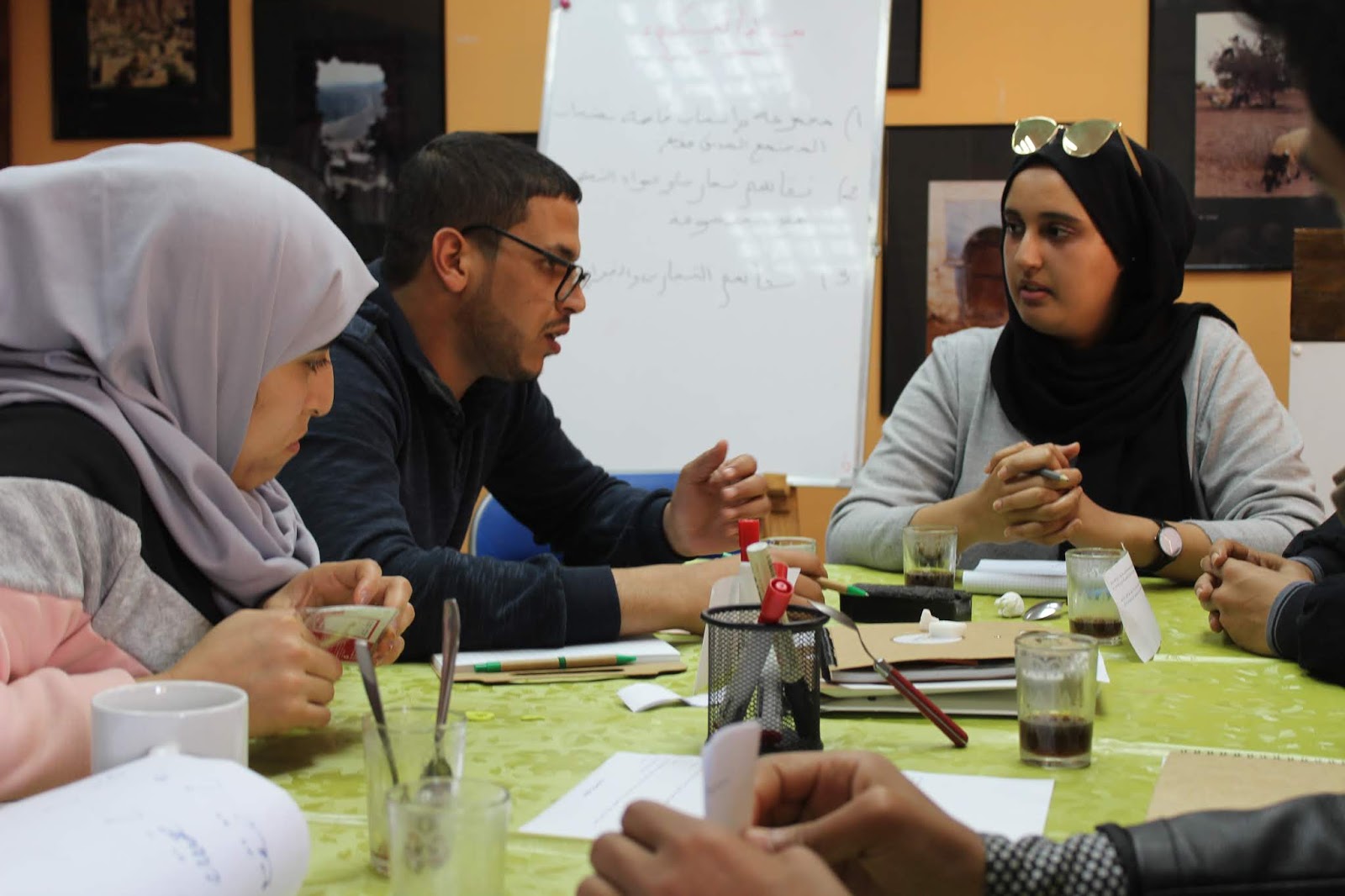
Our trainer Zainab mentoring a group of participants
A lot of exciting activities have been happening at the Capacity Building Project since we first posted about it! The second week of December marked the second workshop for the capacity building workshop for NGOs after our first workshop on Governance and Administration in November.  Our trainer Zineb led a module on Human Resources Management, and our trainer Mustapha led a workshop on Financial Management. We had a lot of ground on management training to cover, and our staff, trainers, and participants rose to the challenge with grace and enthusiasm!
When we are planning the content for these workshops, we make it a priority to include interactive activities. We want to be able to hold people’s attention for an entire daylong event after all the participants already been working for an entire week-- so long lectures are not going to engage our audience very well!
When I was identifying a volunteer’s motivation to serve, I found out that there are three motivations to volunteer: a spiritual or personal connection to the cause, a desire to build skills or gain experience, and an interest in making social connections.
Ilham, a Rise Alumna during her participation in our activities 
When I was drafting our module on volunteer management, my co-manager Hafida pointed out that Dar Si Hmad has already worked with some strong volunteers who could share their experiences and expose our participants to more perspectives on how NGOs can best engage their volunteers. So, we designed a module where we invited three alumni from Dar Si Hmad’s RISE program, a youth empowerment training series, to adopt the profiles of three imaginary volunteers who had different motivations to serve and currently experiencing some difficulties in their work performance. The participants were placed into three groups and took on the role of an NGO board and had to brainstorm solutions so that they could better engage the different volunteers.
Another goal of the Capacity Building Program for NGOs is to get a bunch of smart, ambitious people working to better their communities in the same room together to share ideas. For one session during the Financial Management module, we challenged NGO leaders to work in groups to brainstorm income-generating activities for an imaginary NGO that supports the Mikhaleen, workers who sort garbage for collection and recycling in major cities throughout Morocco.
The participants engaging in the workshop activities 
In addition to envisioning creative ideas to support the financial viability of this NGO, participants also had to assess whether this idea would generate a substantial profit for the NGO based on the project’s estimated start up and operating costs. When these participants were trying to brainstorm a feasible income generating activity, they shared their own professional experiences with each other and ultimately came up with a list of ideas that no one participant would have created entirely on his or her own. These NGO leaders are also getting to know each other better over the course of six months, so we hope that they will be creating mutually beneficial partnerships to support each other’s missions. 
Although a lot of our activities are based on responding to hypothetical situations, we have several strategies to have our participants apply their training in a practical manner. After each session, we assign homework for the participants to use what they have learned to benefit their NGO. One of the assignments from this past session was to have the participants write job descriptions for their staff and volunteer positions. This assignment will help NGO leaders better organize, delegate, and outline workers’ duties and responsibilities, improve their recruitment strategies and provide a template for providing feedback and performance reviews. Each NGO leader has also agreed to launch a new project or campaign based on the management training they have received from the Capacity Building Program.
Team building activities
There are so many people at Dar Si Hmad who work incredibly hard each month to make this workshop training series happen. In addition to working very closely with Hafida, Jamila, our Executive Director, provides feedback and guidance on how to structure the content more effectively. We also collaborate closely with our trainers to draw from their extensive experiences in NGO work so that we can share the most critical aspects of management with our participants in the most engaging format possible.
When it comes to running the logistics of our program, Hafida and I rely on Dar Si Hmad’s driver and caretaker, Abderrahman, to assist us with ironing out the details, which includes a lot of running errands and literal heavy lifting. Aatika works very hard to provide delicious meals to our participants and staff during the training sessions.
Our trainer Mustapha during the Financial Management workshop
There are so many people who have put a lot of time and energy into making the Capacity Building Program a reality, and I am so excited to be working with and learning from so many Moroccan dedicated to social impact.
If you are involved with civil society in Morocco and would like to get more involved with the Capacity Building Project, hang tight! We are planning to release a training manual for trainers and NGO leaders written in Arabic at the end of the project. And, hopefully, we will be able to launch a similar workshop training series again in the future.
The participants during the speed interviews activity