Dar Si Hmad for Development, Education and Culture is an independent nonprofit organization founded in 2010 promoting local culture and sustainable initiatives through education and the integration of scientific ingenuity in Southwest Morocco. We operate North Africa's largest fog harvesting project, providing villages with access to potable water. Our Water School and Girls' E-Learning Programs build capacity in the Anti-Atlas Mountains. Through our Ethnographic Field School, researchers and students engage with local communities in Agadir, Sidi Ifni, and the rural Aït Baamrane region for meaningful cross-cultural exchange.

Showing posts with label water. Show all posts

Sunday, May 30, 2021

The UN 2020 Water and Climate Change report summary - Chapter 13: Technological Innovation and Citizen Knowledge


The thirteenth chapter of the UN 2020 Water and Climate Change report highlights the importance of advancing technological innovation and citizen knowledge to mitigate and adapt to climate change.


The report points to six aspects of science, technology, and innovation that are rapidly evolving: “i) overall assessment and monitoring of water resources and hydrological processes; ii) conservation, recovery and reuse of water resources; iii) adaptation of infrastructures; iv) cost reduction in treatment and distribution processes; v) efficiency of water supply delivery and use; and vi) access to safe drinking water and sanitation.”


Some of these innovations include earth observation, advanced sensor technologies, and information and communication technologies. Earth observation from satellite-based space technologies are able to collect data on weather, climate, and the evolution of water resources around the world. Remote sensing conducted through these satellites can track larger evolutions such as land use change that traditional technology cannot observe. Advanced sensor technologies provide online and real-time monitoring of water availability and quality, which can inform smart water management. This technology can, for example, detect chemical leakages and inform adequate responses. Information and communication technologies include storing data on a shared cloud, artificial intelligence, big data, machine learning, and the internet of things, which are every-day objects connected to the internet (e.g. a water meter with sensors to detect water consumption). Such technologies improve the analysis and interpretation of existing data. The report states that the internet of things can be particularly useful in rural areas, who otherwise have limited means to collect data.


These technological innovations are notable, but they need to be better integrated in decision-making practices. Currently, there is a science-policy gap due to the limited political will and financial and human resources to process, analyze, and present how data can be understood and used by decision makers. 


While decision makers take their time to fill the science-policy gap, the public have options to empower themselves in Free Open Source Software (FOSS) and voluntary action. In countries where accessing such innovative technology is costly, FOSS is a cheap and increasingly popular technology. FOSS allows for users to crowdsource and share relevant data, which can, for example, contribute to early warning systems and validate flood forecasting models. Access to FOSS can empower even the most marginalized populations, including youth, women, the poor, and those in rural areas. Additionally, voluntary action that increases awareness also increases citizen action. There are, for example, climate change guidebooks that promote citizen participation and citizen science projects. An example of this is EarthWatch’s ‘FreshWater Watch,’ which engages the communities it serves to gather samples of freshwater for those samples to be analyzed for quality, pollution, and wildlife. 


The chapter concludes by stressing the importance of science, decision-making, and public participation in creating the most effective and informed mitigation and adaptation measures. 


Written by: Gari DeRamros, Dar Si Hmad's former intern

Wednesday, May 12, 2021

The UN 2020 Water and Climate Change report summary - Chapter 12: Climate Finance, Financial and Economic Considerations


 The UN 2020 Water and Climate Change report provides a plethora of recommendations to prevent and alleviate the water-related effects of climate change, but a major barrier to actualizing these recommendations is financing. Water resources management is incredibly under financed. To meet only the first two targets of SDG 6 (ensure all have access to safe water, sanitation, and hygiene), capital investments must reach US$114 billion per year, which is triple current investments in this infrastructure. To finance the remaining four targets of SDG 6 – which include improving water quality, increasing treated wastewater, improving water efficiency, integrating water resources management, and protecting water-related ecosystems – would require even more capital investment than is currently available. 


The report attributes this lack of financing largely to a ‘business as usual’ mindset, which ignores the risks of climate change and results in a failure to invest in water management. Relevant actors need to consider preventative action and evaluate the risk of not financing in water infrastructure. 


Water management typically depends on traditional sources of financing from the government and development finance, but there are opportunities in climate finance. In 2016, only 2.6% of climate financing went to water management, despite water management benefits for other sectors. 


The report points out two promising trends that may increase climate financing for water projects. First, the increased recognition of water projects’ mitigation potential. 93.8% of climate financing in 2016 went to mitigation, so water projects that also mitigate climate change can more likely access this funding. Second, climate finance is moving towards funding more adaptation measures. For example, the Green Climate Fund is aiming for 50% of its funds to go to mitigation measures and the remaining 50% go to adaptation measures. 


Water projects requesting funding must make themselves appear bankable, or likely to receive funding. Bankable projects are those clearly linked to climate change impacts and are familiar and compliant with funding procedures. Projects that are considered bankable in climate finance explicitly address the causes and/or consequences of climate change. Adaptation projects in particular must also demonstrate their ability to withstand projected climate impacts in the area using scientific evidence. Finally, bankable projects are those that align with already existing policies such as a country’s National Adaptation Plan (per the Paris Agreement) or national development strategies. 


Types of climate financing options

No-regret investments: These investments produce projects that are beneficial regardless of climate impacts, meaning there are gains made in the absence of climate change. Such projects include rainwater harvesting, sustainable groundwater management, improved water storage, wastewater reuse.


Low-regret investments: These investments offset climate risks at a cost, but the cost is small in comparison to benefits from avoiding future losses. Low-regret investments are usually adaptation and resilience-building projects that bring co-benefits to multiple sectors. 


Results-based climate financing: These funds are dispersed once the project achieves pre-determined goals that have been independently verified. These funds typically go projects that improve things already in place like monitoring, reporting and verification capacity, strengthening domestic institutions, or mobilizing the private sector. Since carbon emissions are a well-defined indicator, most results-based investments have been made in climate mitigation projects. 


The Green Climate Fund: Established as the financing mechanism for the Paris Agreement, the Green Climate Fund helps developing countries with projects to mitigate and adapt to climate change. Although the Fund’s goal was to have US$100 billion per year in pledges, it only had US$10.3 billion in 2019. Most of the Fund’s investment priorities involve water management. 


The Global Environment Facility: The Facility, which acts as the financing mechanism for the UNFCCC, provides grants for environmental projects including but not limited to climate change mitigation and adaptation. Since 1992, it has funded around 1,000 mitigation projects and 330 adaptation projects. 


The Adaptation Fund: Established under the Kyoto Protocol, the Fund finances projects that help developing countries adapt to climate change. Since 2010, it has supported 80 adaptation projects and committed $564 million to adaptation and resilience measures. 


Development banks: Banks like the World Bank are increasingly prioritizing climate change in its investments. The World Bank has committed to providing US$200 billion in climate investments from 2021 to 2025. Alternatives to the World Bank are regional development banks that fund projects in their region. These regional development banks are increasingly committed to financing environmental projects. 


Bilateral climate finance: Here, financing will come from one country for the benefit of another. This is seen with countries and regions like the EU, Switzerland, and the United Arab Emirates, as well as funds in developing regions like the Bangladesh Climate Change Trust Fund and the Green Fund in South Africa. Bilateral public climate financing has grown over the years from US$22.5 billion in 2013 to US$27 billion in 2018, with funds primarily financing mitigation projects.


National and subnational climate financing: Each country that has signed onto the Paris Agreement has nationally determined contributions that have spending plans for the government. Money allocated by the government on climate change projects may be used to fund water projects. 


Private sector: The private sector made up 54% of climate financing in 2016, largely coming from project developers, carbon markets, foreign direct investment, insurance, and commercial financial institutions. Green bonds are an emerging source of financing in the private sector. Green bonds are climate bonds that offer “significant global opportunities to mobilize capital at scale for low carbon, climate resilient infrastructure and development efforts,” according to the World Bank. 


Public-private partnerships: Although climate change is not very present in current public-private partnerships, efforts from the World Bank and the Public-Private Infrastructure Advisory Facility are introducing and normalizing climate financing. 


Blended finance: Blended financing incorporates various sources of funding into one project or fund. By having multiple sources of funding, projects can look more attractive to traditional sources of capital. 


Written by: Gari DeRamos, DSH's former intern

Tuesday, March 30, 2021

The UN 2020 Water and Climate Change report summary - Chapter 11: Water Governance for Resilience to climate Change


The eleventh chapter of the UN 2020 Water and Climate Change report states that good governance is key to improving water resources management to adapt and mitigate climate change. Good governance consists of political will, leadership, and action, the understanding that water and climate cut across the entire economy, the importance of inclusive participation and transparency, the role of poverty and inequality in exacerbating vulnerability to climate-related water crises. 


Water governance determines “who gets water, when, and how much.”  The report stresses that governments are not the sole providers of water to people, especially in low-income settings. Instead, the report puts forth a ‘whole-of-society’ approach which recognizes the increasing role of non-state actors in providing water. With increased competition over water resources, however, the need for strong governance, oversight, and coordination in water management is heightened. It is especially important for cross-sectoral stakeholders to be engaged in water resources management, and for water policy to link to national and international climate change policy. 


To improve water management, the report recommends three things: 1) greater public participation to discuss and manage climate risks; 2) building adaptive capacities at multiple levels; and 3) prioritizing risk reduction for socially vulnerable groups. 


Public participation is increasingly important given the increasing variability in the effects of climate change. Making sure that all are involved in the agenda-setting, decision-making, and monitoring of climate change is vital to ensure people are safe from the effects of climate change. The need for public participation is highlighted in Principle 10 of the Rio Declaration on Environment and Development, and sets out three fundamental rights: "access to information, access to public participation and access to justice, as key pillars of sound environmental governance."


Other agents of change include young people, who are increasingly concerned about climate change as demonstrated by the 2019 Global Youth Strike, where 1.4 million students and young adults across 120 countries left school and workplaces to demand climate action. Youth have also been able use local initiatives to raise awareness and advocate for policy recommendations. 


In order to build adaptive capacities at multiple levels, the report recommends ‘adaptive management,’ which is a decision-making process that functions even in uncertainty. Adaptive management understands there is variability in the projected effects of climate change, so they work largely with ‘no-regret’ adaptation measures that have benefits regardless of the impacts of climate change. For example, repairing leaks in urban systems is good for human safety and water sanitation, regardless of the presence of climate change. Under adaptive management, risk assessments should take a bottom-up approach and account for the risks and needs of multiple stakeholders. 


Finally, the report breaks down the importance of reducing vulnerability by combating poverty and inequality. Women and girls from minority ethnic groups, the poor, Indigenous people, and those in remote areas are more vulnerable to the effects of climate change. The report advocates for a human rights-based approach to development, which includes good governance and poverty alleviation. 

Written by: Gari De Ramos, former DSH intern


Wednesday, February 17, 2021

The UN 2020 Water and Climate Change report summary - Chapter 10: Regional Perspectives


The tenth chapter of the UN 2020 Water and Climate Change discusses existing processes and challenges in the world from different regional perspectives. Despite the water-related impacts of climate change transcending borders, regional perspectives are often missing from climate change dialogue, agreements, funding mechanisms, and action. Instead, climate change policy is often framed at the national level.

The report breaks down water-related climate change activities by region, but this summary will only focus on North Africa and West Asia because of Dar Si Hmad’s work in Morocco. The region’s vulnerability to climate change is high across the region, but vulnerability increases in southern areas like the Horn of Africa, the Sahel, and the southwestern part of the Arabian Peninsula.

In North Africa and West Asia, the effects of climate change intersect with complicated socio-economic and political dynamics that affect water at subnational, national, and regional levels. These new dynamics can come from the politicization and weaponization of water resources and displacement, particularly for countries experiencing violent conflict. What further complicates climate change and water management in the region is how “almost all Arab states “are highly interdependent,” because of their shared reliance on transboundary water resources, making integrated regional water policy difficult to achieve. To add further complications, the World Bank estimates that water scarcity exacerbated by climate change will cost up to 6% of the region’s gross domestic product by 2050.

When considering appropriate policy responses in the region, the report focused on Jordan, Mauritania, and Tunisia. All three countries have included water-related measures in their national plan, NDCs, and Adaptation Plan – all at the national and transboundary level. Morocco’s neighbor Tunisia is part of a project called Regional Cooperation in the Water Sector in the Maghreb (CREM), which is funded by German development agencies BMZ and GIZ, along with the Sahara and Sahel Observatory. The goal of the CREM is to improve water resources in Algeria, Morocco, and Tunisia by improving regional cooperation and information-sharing platforms.

The report suggests regional communities around the world should assess the impacts, vulnerabilities, and potential adaptation measures for countries. This is done successfully with the Regional Initiative for the Assessment of Climate Change Impacts on Water Resources and Socio-Economic Vulnerability in the Arab Region (RICCAR), which prioritizes strengthening institutions to act on climate change in the national and regional scale.

Countries and regions should be adopting integrated approaches, which strengthen existing infrastructure across sectors and take action at all levels. Some examples of integrated approaches include investing in better and more accessible information or transporting and treating water, as well as harnessing both adaptation and mitigation benefits.

Instead of regional integrated approaches, many countries operate with nationally determined contributions (NDCs) from the Paris Agreement. Although water-related issues are the most often-cited priority for NDCs adaptation measures, there are variations in how water is mentioned. Countries within the Economic Commission for Europe, for example, place little emphasis on water and instead focus on mitigation measures with their NDCs and have transboundary climate-water initiatives. On the other hand, more than half the NDCs for countries like those in Economic and Social Commission for West Asia do mention water-related measures for institution-building and infrastructure.

Overall, however, there is room to improve the water-related measures of NDCs. The report stated that only half of countries had climate change strategists who were aware of the water sectors plans to adapt and mitigate climate change. Additionally, not all countries are committed to water conservation, especially the Economic and Social Commission for Asia and the Pacific countries. All regions, however, have few concrete proposals that relate to water-related climate adaptation.

Written by: Gari DeRamos, Dar Si Hmad's former Intern


Monday, January 25, 2021

The UN 2020 Water and Climate Change report summary - Chapter 9: Water - Climate - Energy - Food - Environment Nexus


The ninth chapter of the UN 2020 Water and Climate Change report focuses on the links between energy, food and agriculture, the environment, and the effects of climate change on water. The report stresses that adaptation and mitigation measures in one sector can, and are likely to influence water demand, thus affecting water availability for other sectors. Because this link between sectors, groups must assess and respond to the effects of climate change, and such an action has to be done as a collective. By working together, groups can combine their disciplinary knowledge to produce changes across sectors.

The energy perspective
The water sector requires energy and energy production requires water. The water sector’s electricity use is expected to double by 2040, but this can be avoided if water demand decreases (e.g. promoting lifestyle changes) and water management efficiency increases(e.g. making water infrastructure climate-resilient). The energy sector’s water use comes largely from growing biofuels, mining fossil fuels, and the cooling process in thermal power generation. By shifting to alternative energy sources that require relatively little water such as wind and solar photovoltaic, the energy sector can reduce its water consumption.

The food and agriculture perspective

69% of global water withdrawals come from the agriculture sector, highlighting the need for improved water efficiency in the sector. Improved efficiency will not only lead to increased water availability, but also reduce energy needed for getting water. By reducing the agriculture sector’s water and energy demands, they can lower greenhouse gas emissions and mitigate climate change.


Irrigation is a commonly understood method to increase water efficiency in agriculture, but it does not actually lead to water savings at larger scales. This is because farms that produce an already large amount of crops will take these water savings and produce even more crops with the same volume of water as before. The lack of actual water savings highlights the importance of conservation agriculture, which allows soils to retain more water and reduce water and energy demand.


Additionally, the agriculture sector and consumers produce a significant amount of food waste that contributes to global greenhouse gas emissions. By reducing food waste, we can also mitigate climate change.


The land use and ecosystem perspective

Healthy ecosystems can capture carbon far better than human efforts to do the same, but degraded ecosystems can in their turn be a source of carbon emissions. These ecosystems must be maintained and rehabilitated with improved water management. Efforts to improve land use, such as reforestation, will also impact ecosystems, therefore these potential impacts should be accounted for. The report stresses that any land use or ecosystem change in response to climate change should also take into account local environmental and socioeconomic conditions. 


The water supply, sanitation and wastewater treatment perspective 

Improved approaches to this sector can mitigate climate change, especially through treating and reusing wastewater. By reusing water in a circular water management system, the water sector can reduce the amount of energy it needs. Preventing the dispersal of wastewater is also important because wastewater is a source of greenhouse gases. One of the most effective ways to treat wastewater is by constructing wetlands, especially in places with operational and maintenance constraints.


Co-benefits

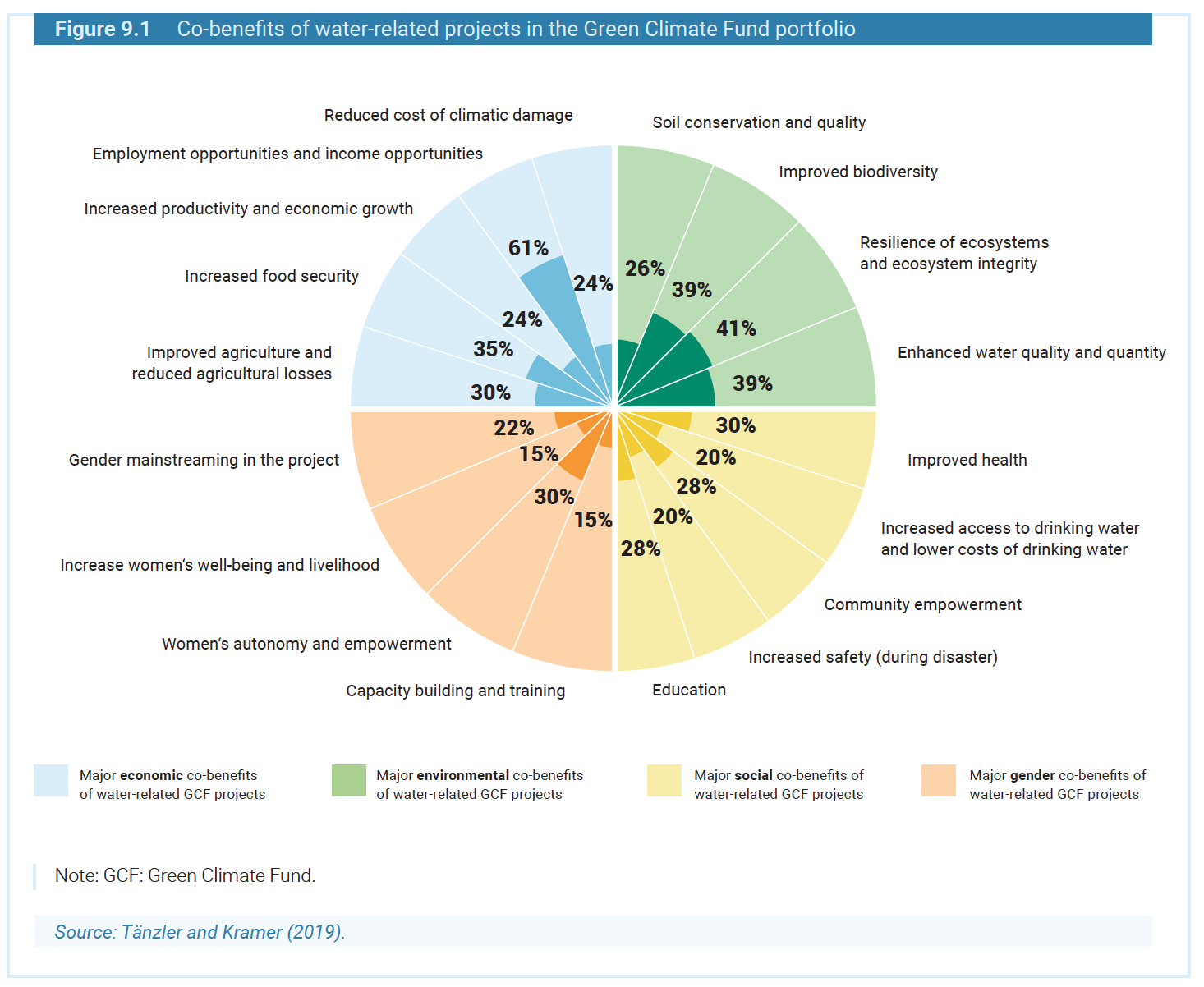
When water-related projects are carried out, there are broader socio-economic co-benefits, such as increased employment and income opportunities. Dar Si Hmad’s fog harvesting project, for example, has given women and girls in the communities we serve the time and opportunity to earn revenue  and go to school. The report states that water-related projects are more likely to get funding if their proposals state specific and realistic co-benefits across sectors.

Written by: Gari DeRamos, DSH's former intern


Tuesday, November 17, 2020

The UN 2020 Water & Climate Change report summary - Chapter 7: Energy & Industry


The seventh chapter of the UN 2020 Water and Climate Change report focuses on the industry and energy sectors. These sectors withdraw 19% and 10% of the world’s freshwater resources respectively, and their combined global water demand is expected to increase to 24% by 2050. Without adaptation and mitigation measures, climate change is likely to significantly impact water-related aspects of both industries. The main challenges for corporations in these industries are water scarcity, flooding, drought, and water stress.


Water Challenges

The availability and reliability of water is key to the functioning of industry and energy businesses who depend on and work with predictability. The uncertain nature of water stress caused by climate change, however, throws a wrench in their plans. Increased water scarcity can impact supply chains, since both sectors consume a lot of water. For energy in particular, any kind of water stressor (e.g. drought, increased water temperature) can drastically affect electricity generation on a global scale.


Extreme weather events such as flooding and drought damage the physical infrastructure and human beings that make up the energy and industry sectors. Additionally, most energy and industry infrastructure exists in coastal areas, which are more vulnerable to sea-level rise and coastal erosion.


Business Risks

Risks to businesses from water-related effects manifest in operation risks, regulatory risks, and reputational risks. Other risks include fluctuations in financial markets, political stability, demographic changes, and population movement.


Operational risks concern the ability of these sectors to function. Water stress can decrease or even stop manufacturing or energy generation. Even before the production stage, these sectors’ supply chains may be affected which can disrupt or damage production equipment and infrastructure. Operational risks also may lead to unsafe working conditions, health effects, absenteeism, and lower productivity for the sectors’ workers.


Regulatory risks concern the presence or absence of climate change adaptation regulations. Although corporations will have to adjust to regulations, the biggest regulatory risk comes from a lack of regulations on water resources, which can lead to uncertain circumstances and limited supply of water. 


With many consumers, investors, and stakeholders becoming increasingly critical of corporate practices as they relate to climate change, corporations may change their behavior to mitigate greenhouse gas emissions and adapt to climate change. Failure to do so may result in bad press and a poor reputation. 


Reactions and opportunities


The report acknowledges that water scarcity and climate change have been recognized by the energy and industry sector for a reasonable amount of time, and stresses that these sectors should see climate change as an opportunity. Corporate reactions to climate change have been broad and include both mitigation and adaptation measures. Corporations can be incentivized to act when thinking about the cost of action versus inaction, where inaction will likely lead to significant losses over time.


For the energy sector, an opportunity exists in lowering both greenhouse gas emissions and water use at the same time. Reducing energy demand and increasing efficiency, but it is not enough. Low-carbon renewable technology such as solar photovoltaic and wind energy are the most promising energy alternatives because they also consume relatively less water. That said, not all renewable energy sources reduce water demand, such as geothermal energy which requires cooling water.


The report also focuses on hydropower, which provides 16% of the world’s electricity and 70% of renewable power. Although hydropower consumes water, water that passes its turbines often travels downstream to be used in other ways. Hydropower, however, is dependent on sufficient water levels. Water scarce areas should think critically and assess projected water levels when considering the creation of hydropower infrastructure such as dams.


For the industry sector, an opportunity exists in decarbonizing their production processes. Some examples of process changes include using low-cost zero-carbon electricity for high-temperature electric furnaces, or switching to nuclear or hydropower. These measures would bring emissions to near zero.


Both sectors can best adapt to the water-related impacts of climate change by adopting circular water management. Instead of linear water management where water is contaminated in the production process to be discarded, circular water use treats or keeps clean water to circle back and be reused in the process.


It is important to note that technology is not a barrier to circular water management, rather regulation, financial resources, awareness, and dialogue are what is slowing the shift to this new way of managing water. Research has found that women are more likely to support circular water management and have more comprehensive approaches in water management, even but the energy sector is largely male-dominated. Research predicts that if more women had greater influence in decision-making, changes like shifts to circular water management would more likely come to fruition.


Moving forward


The report ends this chapter by stressing the energy and industry sectors will have to move away from a ‘business-as-usual’ and ‘quarterly capitalism’ mindset. Corporations will need to acknowledge the long-term risks of doing nothing to mitigate or adapt to climate change, and should instead see climate change as an opportunity to avoid unwanted costs.


Written by: Gari DeRamos, former DSH intern


Friday, October 23, 2020

The UN 2020 Water & Climate Change report summary - Chapter 6: Agriculture and Food Security


The climate is what affects and determines agriculture; so agriculture has adapted to temperature and precipitation for thousands of years and adapted to  day-to-day weather variations and long-term seasonal shifts. Climate change, however, is accelerating and intensifying these shifts, affecting those in the agriculture industry. 

The rural poor who depend on agriculture are especially at risk. It is expected that rural poverty will increase because of climate change, because they may lose their livelihood due principally to water scarcity, facing chronic poverty, hunger and economic dislocation. 80% of drought impacts are felt by the rural poor, so it is important they have accessible technology capable of informing them of weather patterns, allowing them then to adapt and shift production alongside climatic variability.

Climate change will impact the agriculture industry’s water management in a magnitude of ways, which are described in Table 6.1 of the report.

Agricultural water demand comes largely from irrigation, which is responsible for 69% of water withdrawals on this planet. The demand for irrigated land is a direct result of the expansion and intensification of crop production. Unfortunately, the effectiveness of global irrigation applications are around 50% when set against water withdrawals of 2,769 km3/yr, meaning irrigation is not as effective as it can and certainly should be. Many believe increased irrigation will result in reduced water withdrawal, but this assumption is ill-founded. Groundwater, on the other hand, is underestimated as a source of water for agriculture and rural development. Shallow and deep groundwater extraction can be beneficial for smaller scale agricultural production during dry-seasons and periods of drought. Outside of irrigation and groundwater, the report also examines global meat consumption, fish production, and biofuel production as components for the agriculture sector that impact and are affected by climate change. 

Adaptation and Mitigation

Agricultural water management must adapt its modes of production to cope with water scarcity and water excess. The report highly recommends a set of ‘Climate-Smart Agriculture’ (CSA) approaches to land and water management, such as soil conversion to anticipate climatic variability and carbon sequestration to reduce greenhouse gas emissions. Agriculture that depends on rain can optimize soil by adapting to climate change, but will ultimately depend on the presence of rainfall.

CSA also stresses the importance of climate-informed measures to inform water resource management and agricultural development. Examples of climate-informed measures include seasonal climate forecasts for months and years, near-real-time weather information, in-situ soil moisture technology, integrating basin-level hydrology and recharge regimes to CSA, and increased investment and planning in agriculture water management. 

The agriculture industry also needs to mitigate climate change by decarbonizing and reducing their greenhouse gas emissions. The agriculture, forestry, and other land use sectors produce roughly 23% of the anthropogenic greenhouse gas emissions from 2007 to 2016. Although the agriculture sector's share of total greenhouse gas emissions is decreasing, its net emissions are expected to increase. The sector’s greenhouse gas emissions are largely driven by turning ecosystems such as forests and wetlands into land for agriculture production. To reduce greenhouse gas emissions, the report recommends improving drainage management in natural wetlands and wetland forests, reducing deforestation and forest degradation, and reforesting for carbon sequestration. 

The report concludes its chapter on agriculture by restating the importance of scaling adaptation and mitigation measures for the community, sector, or country’s needs, which can be seen in the image below. 


Written by: Gari DeRamos, Dar Si Hmad's former intern


Wednesday, September 23, 2020

The UN 2020 Water & Climate Change report summary: Chapter 5 - Human Health Impacts related to Water, Sanitation and Climate Change

Climate change has and will continue to have severe water-related impacts on health, especially the poorest and most vulnerable populations that will deepen inequalities within and between countries. Water-related health impacts of climate change include the increased spread of food-, water- and vector-borne diseases, deaths and injury associated with extreme weather events, and undernutrition caused by food shortages, droughts, and floods. Mental health may also be impacted, but it will be harder to quantify. It is projected that climate change will cause an additional 250,000 deaths yearly by 2030.

The UN 2020 Water and Climate Change report recommends immediate coordinated action that draws on the principles of the ‘One Health’ approach, which considers humans, animals, and ecosystems in its public health interventions. The report stresses the importance of the government and healthcare sector factoring in water and sanitation in healthcare policies. Through the Paris Agreement, the international community has provided mandates for stronger action to protect human health from climate risks. Mitigation efforts that prevent global temperatures from increasing by 2ºC are also important, especially to prevent the spread of diseases that thrive in warmer temperatures. 

Trends in water-related morbidity and mortality


Ensuring access to safe water and sanitation will not only improve quality of life for millions, but also realize the human right to water. To achieve water access for all, there needs to be better management of water resources to prevent the spread of disease, such as making sure bodies of freshwater are not polluted and that the food production sector has adequate access to safe water. 

Around the world, nearly two million preventable deaths occur because of inadequate water and sanitation, with most of these preventable deaths are happening to children under the age of five. Mortality associated with water- and sanitation-related diseases is decreasing, but not quickly enough. The burden of these illnesses and death fall on women and girls, who lose opportunities for work and education due to water collection tasks and have difficulties in menstrual hygiene management. 

Health risks associated with climate change

Climate change is already impacting human health, but it is disproportionately impacting the poorest and most vulnerable populations, which is why climate change is considered to be a poverty multiplier. There are direct, indirect, and mental health water-related impacts from climate change. Direct impacts include physiological effects from exposure to high temperatures, increase in respiratory diseases, and death or injury from extreme weather events. Indirect effects include those caused by ecological changes, such as water insecurity because of drought. Mental health impacts include stress from loss of culture, loss of a way of life, and more. 

Additionally, climate change is undermining the progress made on safe water and sanitation management that is supposed to prevent these water-related health risks from happening. In some regions, cases or diarrhea are expected to increase to 10% by 2030 because of diseases spread by climate change. Existing water and sanitation infrastructure is also at risk of being damaged by extreme weather events like floods, which will worsen water and sanitation quality. 

Increased temperatures will affect water availability and food production, so another major concern is undernutrition, which the report anticipates to be “one of the greatest threats to health resulting from climate change.” The report predicts that 540-590 million people, particularly children and the elderly, will be undernourished if global temperatures warm by 2ºC. 

Water supply and response options

Adapting water and sanitation infrastructure so they make room for resilience is of the utmost importance. The following six components of health systems should be considered when adapting infrastructure: policy and policy and governance, financing, service delivery, technologies and infrastructure, workforce, and information systems. Other measures including data collection, disaster response and rehabilitation, and behavior change programs can also be effective in adapting to climate change. 

Just as the water and sanitation sector should take health into account, the health sector should take water and sanitation into account. Specifically, the healthcare sector should ensure that water- and sanitation-related climate risks are factored into their healthcare policies. 

Written by: Gari De Ramos, DSH former intern