Dar Si Hmad for Development, Education and Culture is an independent nonprofit organization founded in 2010 promoting local culture and sustainable initiatives through education and the integration of scientific ingenuity in Southwest Morocco. We operate North Africa's largest fog harvesting project, providing villages with access to potable water. Our Water School and Girls' E-Learning Programs build capacity in the Anti-Atlas Mountains. Through our Ethnographic Field School, researchers and students engage with local communities in Agadir, Sidi Ifni, and the rural Aït Baamrane region for meaningful cross-cultural exchange.

Showing posts with label women's empowerment. Show all posts

Saturday, October 15, 2016

International Day of Rural Women

Thanks to Environmental Youth Ambassador Mohamed Ouabbou for this guest blog post about the International Day of Rural Women! We are proud to be working with young Moroccan male feminists.
This post is part of our "Road to Marrakech" social media campaign leading up to COP22. The first Sustainable Development Goal we are highlighting is SDG 5: Gender Equality. From all of us at Dar Si Hmad, happy Rural Women's Day!
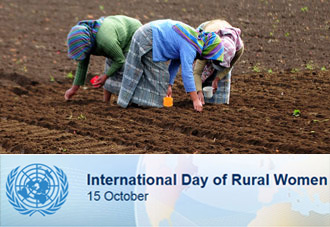

The first International Day of Rural Women was observed on October 15, 2008. The idea of honoring rural women with a special day was put forward at the Fourth World Conference on Women held in Beijing in 1995 - the same event where then-First Lady of the United States Hillary Clinton first declared "women's rights are human rights". It was suggested that this day be celebrated as World Rural Women’s Day.

The United Nations International Day of Rural Women celebrates and honors the role of rural women who make up one-quarter of the world's population. Rural women are often the primary providers of food and sustenance for their families and contribute to the majority of global food production by constantly adapting to their environments with new agricultural techniques. They do this while frequently working in situations of poverty - bearing in mind that 76 percent of the world's extreme poor live in rural areas.

Today's commemoration aims is to address the human rights of all rural women, improving their working conditions and recognizing the important role they play in society. This is a vital step in ensuring the sustainability of human-nature systems.

In Morocco, many women survive through subsistence farming with limited other opportunities available to them. Poor infrastructure and limited access to credit means that raising enough income to support children's schooling is made more difficult in female-headed households - creating a vicious cycle of poverty and poor education.

Since its founding in 2010, Dar Si Hmad works to support mothers to improve their livelihoods in Southwest Morocco's rural areas. The organization utilizes pioneering research and technology and uses education and ecology to promote intercultural exchange and participatory development facilitating sustainable growth for the region. Some of projects particularly relevant to the International Day of Rural Women are:
  • The world’s largest operational fog-harvesting system located in Aït Baamrane in Southwest Morocco. The system includes 600 m2 of nets that harvest fresh water from fog, serving more than 400 rural Berber residents, the majority of them women. Rural women in these villages once held the frequently burdensome role of fetching water. Having water piped directly into their homes means that residents no longer need to travel long distances for potable water. By controlling the household water supply and monitoring the fog system, women continue to maintain power as water guardians.
  • Women's Empowerment trainings ensure that women of all backgrounds have the skills they need to take on leadership and decision-making roles, allowing for truly sustainable development.
  • Dar Si Hmad’s E-Learning program helps young women in Aït Baamrane to succeed in national exams, opening doors to a wider range of opportunities and experiences.
  • The Water School uses environmental concerns to engage rural communities in experiential learning. Children aged 7-13 explore the societal and natural realities of their world, expanding their capacities for and understandings of global change.
  • Through the Ethnographic Field School, Dar Si Hmad invites international researchers and students to be a part of their inspiring work with local communities by facilitating academic and cultural programs and service learning. These visits provide new experiences for communities and help reduce the many stereotypes frequently held about rural women.
Two weeks ago, the above programs won a prestigious award from the United Nations Framework Convention on Climate Change (UNFCCC) in recognition of their support for rural women. Momentum for Change recognizes the transformative climate action projects that are already taking place on the ground. Momentum for Change is spearheaded by the UN Climate Change secretariat as part of wider efforts to mobilize action and ambition as national governments work toward implementing the Paris Climate Change Agreement and the Sustainable Development Goals. Dar Si Hmad won under the "Women for Results" focus area that showcases women-led initiatives addressing climate change. Our "Women-Led Fog Harvesting for a Resilient, Sustainable Ecosystem" is gaining international attention and more groups are exploring how they can borrow from our learning in fog-harvesting, environmental education, and women-centered rural development to improve their own work.

While today's celebrations focus on the specific situations of  rural women, it is important to also acknowledge the value of rural women to economic growth, food security, and people's empowerment. As former UN Secretary-General and Nobel Peace Prize Laureate Kofi Annan said, "When women thrive, all of society benefits."


Join Dar Si Hmad on Twitter, Instagram, and Facebook to learn more about how we are promoting and empowering rural women to help achieve the Sustainable Development Goals.

Friday, October 14, 2016

SDG 5: Gender Equality

The fifth Sustainble Development Goal aims to "Achieve gender equality and empower all women and girls".


Each of the Sustainable Development Goals includes a number of specific targets. In our lead-up to COP22, Dar Si Hmad will be highlighting a few of the SDGs and how we partner with local communities and global initiatives to make progress.

For the United Nations and SDGs, Gender Equality means:
  • ending all forms of discrimination against all women and girls everywhere;
  • eliminating all forms of violence against all women and girls in the public and private spheres, including trafficking and sexual and other types of exploitation; 
  • eliminating all harmful practices, such as child, early and forced marriage and female genital mutilation; recognizing and valuing unpaid care and domestic work through the provision of public services, infrastructure and social protection policies and the promotion of shared responsibility within the household and the family as nationally appropriate; 
  • ensuring women’s full and effective participation and equal opportunities for leadership at all levels of decision-making in political, economic and public life;
  • ensuring universal access to sexual and reproductive health and reproductive rights as agreed in accordance with the Programme of Action of the International Conference on Population and Development and the Beijing Platform for Action and the outcome documents of their review conferences;
  • undertaking reforms to give women equal rights to economic resources, as well as access to ownership and control over land and other forms of property, financial services, inheritance and natural resources, in accordance with national laws;
  • enhancing the use of enabling technology, in particular information and communications technology, to promote the empowerment of women; and
  • adopting and strengthening sound policies and enforceable legislation for the promotion of gender equality and the empowerment of all women and girls at all level.
For Dar Si Hmad, gender equality means making sure everyone has the opportunity to make the most of their lives and their communities. We do this locally, nationally, and globally through a variety of programmes.

Tomorrow for the International Day of Rural Women, we will highlight the work we do with Amazigh women in Aït Baamrane's fog villages. Dar Si Hmad conducts bi-monthly capacity-building trainings for women, teaching functional literacy and mobile technologies. The workshops also explore cooperatives as routes to economic empowerment. These seminars were created to ensure that the time saved by the in-home water access brought through our award-winning fog project is invested in future generations of female leaders. The women have subsequently developed tools and skills and are on their way to becoming economically autonomous.

Meanwhile with younger girls, Dar Si Hmad promotes a variety of educational opportunities. Women around the world are discouraged from pursuing science, technology, engineering, and mathematics (STEM) fields - as well as higher education in general - by persistent sexist stereotypes. These negative messages sink in at a very early age and are reinforced throughout girls' lives. The Water School seeks to dismantle these internalized ideas through lessons on environmental science, providing opportunities for Berber girls to explore STEM fields. Our Streaming the Water School episode on "Girls in STEM" highlights the Water School's impact on young girls. For teenagers, the Girls' E-Learning program brings computer-based tutorials to young women in rural areas to help them prepare for exams, improving their access to higher education. As young adults, the RISE & THRIVE programs engage university and vocational students in professional skills development.

Nationally, Dar Si Hmad is a member of the Search for Common Ground National Coalition on "Empowerment & Rights". The Coalition focuses on strengthening the advocacy of women's rights in civil society organizations and engages in collaborative, non-adversarial campaigning for legislative reform. Our own Souad Kadi serves as an NGO Representative to the National Coalition to work toward increasing cooperation with key society stakeholders and reducing economic constraints for women.

On the international scale, Dar Si Hmad is proud to be a part of Michelle Obama's Let Girls Learn initiative. Let Girls Learn works "to ensure adolescent girls get the education they deserve. The program recognizes that around the world, girls face complex physical, cultural, and financial barriers in accessing education. As a girl grows older the fight to get an education becomes even harder. Her family must be willing to pay school fees. She may have a long, unsafe walk to school. She may be forced to marry. And she often lacks the support she needs to learn. Yet, we know that educating girls can transform lives, families, communities, and entire countries. When girls are educated, they lead healthier and more productive lives. They gain the skills, knowledge, and confidence to break the cycle of poverty and help strengthen their societies. It’s time to Let Girls Learn."

In the documentary "We Will Rise: Michelle Obama's Mission to Educate Girls Around the World", the First Lady of the United States, actresses Meryl Streep and Freida Pinto, and CNN's Isha Sesay journey to Morocco and Liberia, where they meet young women overcoming incredible odds to change their lives. You can read more about Michelle Obama's passion for girls' education in this guest piece written by the First Lady for CNN.

Last Tuesday October 11th, in celebration of the International Day of The Girl, "We Will Rise" premiered at The White House. Two of our RISE Alumni, Zahra and Hasna, and our Director Dr Jamila Bargach were invited to The White House to attend the premiere.


We are proud to be working to Let Girls Learn - in Aït Baamrane, Agadir, and around the world.
Follow us on Twitter, Instagram, and Facebook to learn more about how we are doing this, the Sustainable Development Goals, COP22, and our work to fight for global gender equality and promote sustainable development for all.