Dar Si Hmad for Development, Education and Culture is an independent nonprofit organization founded in 2010 promoting local culture and sustainable initiatives through education and the integration of scientific ingenuity in Southwest Morocco. We operate North Africa's largest fog harvesting project, providing villages with access to potable water. Our Water School and Girls' E-Learning Programs build capacity in the Anti-Atlas Mountains. Through our Ethnographic Field School, researchers and students engage with local communities in Agadir, Sidi Ifni, and the rural Aït Baamrane region for meaningful cross-cultural exchange.

Showing posts with label French. Show all posts

Wednesday, September 27, 2017

A Summer Breeze… from the DSH Agadir Center

Our blog at Dar Si Hmad has been silent for few months now… we have been caught in the midst of adjusting to administrative changes and taking time to constructively reflect on the work we so passionately do with and for our communities.

Safe drinking water has been flowing to all the communities in Ait Baamrane, we have now 8 more villages not to have suffered through the scorching summer-heat to go fetch meager water-amounts from distant wells. They have celebrated the holy month of Ramadan with even more happiness, celebrating water available within the households.

This past summer we have hosted high-school pupils from under-represented groups in the US and we are extremely proud to say that this first experience was an astounding success. The EFS manager Maisie Breit and the DSH team committed all their energy and know-how to delivering a successful program. Gender, race, and indigenous culture were presented, discussed, and scrutinized in different social contexts, thus unveiling how structures of power function in our multiple worlds today.

This summer we have also hosted two very promising researchers from the US, all working on Agadir as their research-site. Their work on ecological issues facing this touristic city is not only timely, but ask key questions as water scarcity and water-waste.  Some of these questions were subsequently taken up by the Climate Chance meetings to have just taken place here in Agadir from the 11th-to 13th of September.  All NGO actors coming together to continue and/or initiate the work for a better stewardship and care of our planet. DSH was an active actor during these meetings.

This summer we have hired a new office manager, Abbes Benaissa who comes with a rich experience working in NGOs in Morocco and overseas. We are learning and benefiting from his “past life” and discovering all the enriching new paths in front of us.  New ways of collaborating with other environmentally minded NGOs, with European based volunteers, and with a host of bohemians, free-spirits, folks in love with life and with all the beauty we learn from observing it.

This spring, we also hired a new RISE program officer, Soufian Aaraichi. Another cool breeze of calm and serenity. With Soufian, just like Abbes, other types of free-spirits are joining the organization and taking the environmental work to a new level of connections. All are welcoming and carry the promise of a better today.

From left to right: Soufian, Abbès from their excursion in Wim-Timdouine
This summer we were blessed by a very special visit. All fog-projects in the world place the Chilean case on a pedestal of sorts, it was the first, large-scale and most successful initiative to have endowed fog with the title of a noteworthy source of water. The Fundación un Alto en el Desierto came to visit our fog-project and see how the new CloudFishers function. The blessing of these prophets of fog from Chile to Morocco was a true inspiration to nurture our continuing determination.
From left to right: Mounir Abbar, Natalia Robert and Nicolas Schneider (director and president of Un Alto En El Desierto), Aïssa Derhem


This summer, Soufian Aaraichi, Khadija Changa and Jamila Bargach, we all travelled to the Northern part of Morocco and worked in the mountains close to the Fnideq.  This region is known by water-scarcity during the summer and by the presence of thick fog.  Our field-work concerned some 3 villages in order to evaluate the fog-potential and have the 192 households have access to water even during the dry-season.
Jamila, Khadija and Soufian enjoying the view on the stone quarry.

And finally this summer, we were offered some naked land in the mountains of Ait Baamrane in order to create a fog-fed farm employing the principles of permaculture. Greening the desert, and why not?  This small experiment in which the goal is to mitigate the encroaching Sahara in the region where we work. We are in the process of studying the project and looking into this future of possibilities.


So yes, our summer was quite busy and we are just so happy about it!

Wednesday, January 13, 2016

Morocco's Rich Language Landscape: Studying Darija & Berber at Dar Si Hmad

As a language enthusiast, Morocco’s linguistic diversity never ceases to amaze me. As a native Spanish speaker, self-proclaimed Francophile turned Arabic aficionado, I was drawn to Morocco because of its convoluted linguistic intersections. While interning at Dar Si Hmad, I used some of my spare time to learn Darija and some basic Tachelhit with the excellent instructors at the Ethnographic Field School. I also look forward to continuing my studies of conversational Darija and Modern Standard Arabic during the remainder of my time at Dar Si Hmad.


But what inspired me to study three languages over the course of my time with DSH?


The linguistic landscape of Morocco is has been molded by its heritage, colonial past and aspirations to be a major player in the global stage. In Morocco, depending on where you are, you may encounter five or more languages on a daily basis: Moroccan Darija, Tamazight regional dialects, Standard Arabic, French, Hassaniya, Spanish and English. Each of these languages carry significance in Morocco’s cultural history and serve unique functions in society. We can certainly say that Moroccans are natural polyglots, as many speak at least three to four languages by the time they reach adulthood!


To start out, Moroccan Darija is a colloquial dialect that has strong foundations in classical Arabic, or Qur’anic Arabic, which came to this region from the Arabian peninsula during the Islamic Conquests and Arabization of the “Maghreb” in the 7th to 12th century. Classical Arabic has evolved into Modern Standard Arabic (MSA), which is a commonly used and mutually understood written and spoken version of Arabic throughout the Arab world. However, MSA is not a widely spoken language. It is reserved for formal professional or academic settings and literary texts, such as books, newspapers, magazines, and official documents. Due to MSA’s function as a strictly formal version of Arabic, each country throughout the Arabic-speaking world has their own colloquial dialect that is an off-shoot of Arabic. The further away you go from the Arabian peninsula and the Middle East, the greater variety you find in the spoken Arabic of the people in those different countries. A linguistic comparison can be made to dialectal diversity you would notice between Murcian castilian and Andalusian castilian in Spain, for example.


Moroccan Darija is the language used in everyday life in Morocco. It is heavily influenced by the languages spoken by the Spanish, French and Portuguese colonizers of this region who came and left in waves before Morocco officially gained its independence in 1956. For example, semana, the Spanish work for week is simana in Darija. In addition, the Darija word for hospital sbetar bears close resemblance to the French word hopital. These are just some of many examples of words that exist in Darija that originate from the languages of colonial powers. To further complicate the situation, the Darija spoken in the northern part of the country can vary from the Darija spoken in the south. Moroccans themselves recognize linguistic differences between Fassi Darija and “Casaoui” Darija, for the Arabic variety spoken in Fes and Casablanca, respectively.


While Darija is mainly spoken in the streets, it can often influence Moroccans when they speak a more refined MSA in formal settings, causing there to be a middle version of semi-formal Arabic. Despite this fragmented picture of linguistic differences, many Moroccans hold on dearly to Arabic as their main language due to its association as the language of Islam, or the language in which the Holy Qu’ran was received by Prophet Mohammed. The place for MSA in a Moroccan society that is mostly Darija-speaking has been the topic of much debate in Morocco.

timthumb.php

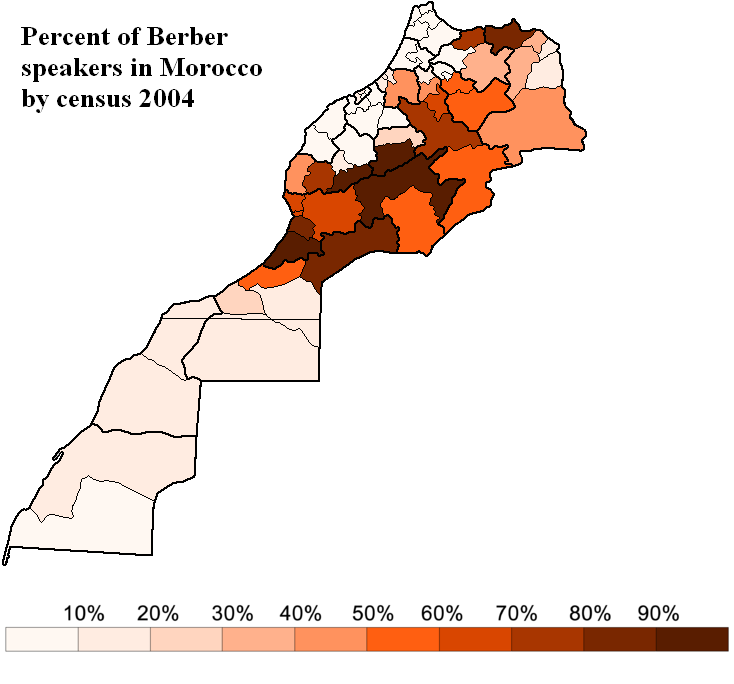
Furthermore, there are Amazigh languages spoken by the indigenous people of Morocco. The word “Berber” has been often used to refer to the Amazigh people, but some perceive it as derogatory term because it derives from barbarian, which was used by colonial powers when they first arrived in the country. However, “Amazigh” actually means “free and noble men,” an identity that continues to be a point of pride for many Moroccan Amazighen. While statistics on what percentage of Moroccans are of Amazigh background vary, a great majority of Moroccans claim Amazigh roots. There are three main dialects of Amazigh spoken in Morocco: Tirifit in the north, Tamazight in the center, and Tachelhit in the south of the country. The dialects that are closer in geographic proximity to each other can be understood by native Amazigh speakers. However, a native Tachelhit-speaker from Agadir will find it very difficult to understand a native-Tirifit speaker from Nador. While Amazigh languages may be transcribed in both Latin and Arabic characters, the ancient Tifinagh alphabet was standardized and officially recognized by Morocco in 2003. Through the efforts of some Amazigh nationalists, Tamazight was recognized as an official language in Morocco when the new constitution was passed by King Mohammed V in 2011. Tamazight is mostly spoken at home among family members and relatives. However, it has become increasingly present in Moroccan public spaces. For example, administrative buildings now provide signs translated in Tifinagh and Arabic scripts, Tamazight is taught at select public schools, and locals in predominantly-Amazigh cities like Agadir speak it casually amongst themselves.

Percent_of_Berber_speakers_in_Morocco_by_census_2004.png

While the colonial period officially ended in 1956 with the abolition of the French protectorate, traces of the colonial influence are still undeniably present in Moroccan society, especially when it comes to language. Following decades of French and Spanish influence in most of the country, the languages of colonial powers have made their way into almost all spheres of life. When colonial powers finally withdrew from the country, newly independent Moroccans found themselves inheriting colonial education systems and governmental structures. For this reason, French and, to a lesser degree, Spanish have left their mark on the Moroccan linguistic landscape. Spanish is widely understood and spoken in northern Morocco (and Dar Si Hmad’s hometown of Sidi Ifni). Places in the vicinity of Tangier and Tetouan have major Spanish-speaking populations, which is fueled by tourism from nearby Spain and the Spanish enclaves of Ceuta and Melilla. While Spanish is not spoken at home or enforced at school, you may find Moroccans speaking it with each other or tourists in the area.


French has a longer and more complex history in Morocco. Due to the French colonial influence in pre-state and newly independent government institutions, the French language has maintained a strong presence in Moroccan society. While Moroccans learn Arabic, most who pursue education beyond the primary level can speak French at least conversationally. By the time Moroccans reach the university level in the humanities, almost all of their coursework is likely to be in French. Many Moroccans believe that French language skills are necessary in order to progress professionally in the country.


Similarly, English is now starting to gain popularity in Morocco as a global language, especially in a country that aims to open itself up to international business. Interestingly enough, Moroccan youth also see learning English instead of French as an act of resistance to France’s cultural hegemony over Morocco. Nearly half of the Moroccan university students participating in Dar Si Hmad’s RISE program prefer English over French for professional communication.

As you can tell, the linguistic landscape of Morocco is as complex as it is diverse, mirroring the richness of Moroccan society. There is no doubt that many linguists are attracted to Morocco because of its unique diglossic situation in order to make sense of this complexity. Certainly, the country will never cease to inspire those who are willing to take the time to unpack its many layers.