Dar Si Hmad for Development, Education and Culture is an independent nonprofit organization founded in 2010 promoting local culture and sustainable initiatives through education and the integration of scientific ingenuity in Southwest Morocco. We operate North Africa's largest fog harvesting project, providing villages with access to potable water. Our Water School and Girls' E-Learning Programs build capacity in the Anti-Atlas Mountains. Through our Ethnographic Field School, researchers and students engage with local communities in Agadir, Sidi Ifni, and the rural Aït Baamrane region for meaningful cross-cultural exchange.

Wednesday, May 13, 2020

Dar Si Hmad Highlights of April 2020


In our previous blog article on Dar Si Hmad’s highlights of March 2020, you learnt that we all went under confinement during the couple last weeks of the month. Well, the situation has remained unchanged and we, happily, continue some of the work. Read on through this article to find out how creative we have been with this physical confinement that ensures our common safety!


Please expect a whole new NGO website. Working from home was the ideal time to do some desk-based work and revise our website. So stay connected because you will soon have our updates on www.darsihmad.org where a new institutional video will welcome you. All Dar Si Hmad team is excited about this long due update!

We virtually hosted a new intern who has contributed to making the UN Water and Climate Change chapters accessible to everyone. Dar Si Hmad had her, and this is for the first time ever, working remotely from the United States. Her Name is Ana Margarita “Gari” De Ramos, she first reached out to us during her Journalism and New Media training that she was taking in the School of International Training (SIT), and as part of the program’s assignment, all participants must complete an internship which she did with us from home due to the current global health situation. Gari has contributed with some great pieces of work, you will learn tremendously from her essays; continue being tuned to read them .

The second event, our Green Fridays - Ljamae Azgzaw  did take place but in a novel way, lecturer Lahcen Lquoute, participants and Dar Si Hmad’s staff organized it online. The session was around an amazigh Ode about the precious Argan Tree, the participants were invited to read and interpret. This topic was of great importance because the Argan tree plays a big role in maintaining a balanced ecosystem in the southwest region of Morocco, and also because it serves social and economic purposes too. Having this event held on a virtual platform was advantageous in the sense that it brought people living outside of Agadir to join the discussion, and thus the session benefited a larger public.

Apart from what Dar Si Hmad had within the organization, April 2020 contained many dates that were worthy of commemoration, at least on our social media platforms. The first date was the 7th of April:  World Health Day which indeed concerns us especially with the Coronavirus spread all over the world. The UN Forum of Indigenous people was another event we were excited for, especially that the theme of the year was around the role of indigenous people in implementing the Sustainable Development Goals. The event was postponed considering the current health situation. And for the exact same reason, Dar Si Hmad wasn’t able to celebrate its 10th anniversary on April 20. We are however very grateful for all those of you who actively engaged with us on our birthday’s post by sharing their favorite memories with DSH on their Instagram stories. Indeed, those were cherished moments for us too. And then came Earth Day on the 22nd, a day we normally celebrate, but alas, the circumstances did not allow. And finally came the English Language day on the 23rd, which was an opportunity to shoutout to all the native English language speakers who joined DSH’s language center and excelled in learning one of the Arabic and Tamazight varieties we offer.

Finally, April 2020 was concluded by the arrival of Ramadan which is the opportune time to invite people into considering the ecological awareness as an important component of their spirituality. For that, we have been posting daily quotes that teach and call upon revisiting one’s relationship with nature and the ecosystem. We believe that strengthening one’s ecological spirituality leads to building a healthier and more sustainable world. Thus, Dar Si Hmad will make sure to continue spreading this conviction even after the end of Ramadan.

Now that April is over, Dar Si Hmad is preparing a surprise for you this May. A new big important project that will make another milestone in the organization’s history, but also of that of our partners in the project. Stay tuned for the next session of Ljamae Azgzaw, on the last Friday of this month to learn more about what’s coming!


Wednesday, May 6, 2020

The UN 2020 Water & Climate Change report summary: The executive summary


Water is vital to life. The absence of water will threaten our human rights to water and sanitation. Climate change affects both the quantity and quality of water. These effects manifest as water scarcity, drought, pollution, uncertainty about precipitation, extreme weather and more. Water also effects every aspect of our life and economy, including through human health, food security, energy production, economy growth, ecosystems, and industrial growth.


In the nine-page executive summary of the UN's World Water Development Report 2020: Water and Climate Change, it is made clear that the world and its governments must prioritize creative adaptation and mitigation strategies to ensure peoples’ access to water. The report states that adaptation measures (which moderate harm or exploit beneficial opportunities from climate change) are more present in water-related sectors, whereas mitigation measures (which are human interventions that reduce the sources or enhance the sinks of greenhouse gases) are not yet recognized in the water sector.


It is increasingly necessary to improve and adapt water-related infrastructure. The report also recommends increased investment in unconventional water sources, which include. Some water reuse efforts, desalination plants, the restoration and conservation of wetlands, and fog water collection projects like what we have at Dar Si Hmad.


Food and agriculture also need to be reformed, but face two challenges. First, the industry must adapt its existing models for shifts in the climate – e.g. adjust farming for increased temperatures. Second, the industry must decarbonize through carbon sequestration, emissions reduction through land and water management, or climate-smart agriculture.


Climate change initiatives should also spotlight energy, since two-thirds of the world’s anthropogenic GHGs come from energy production and use. The world must reduce energy demand and increase energy efficiency, and an initial step to doing this is increasing the use of low-carbon renewable energy.


It is also important to consider the interlinkages between climate change adaptation and mitigation measures. Changes in one sector and directly influence the sector’s water demand, which can in turn alter water availability for other sectors. For example, water use requires energy, which leads to water reduction. If our sources of energy change or we need less energy, we would consume less water, produce less GHG, and mitigate climate change.

In order to adapt to and mitigate climate change, we will also need technological innovation that goes beyond our current abilities to measure and react to climate change. The report uses remote sensing technologies as a newer example that can identify large-scale processes not easily seen in traditional observation methods. For example, remote sensing data for crop loss assessment can inform researchers on the effects of flooding in certain regions. All of this, however, needs to be financed. There are two things that must be done for financing climate change’s impacts on water. First, we must recognize the potential of mitigation in water and sanitation projects, and also increase emphasis on financing climate adaptation.


Climate change will also impact the water systems of human settlement. When water is scarce, water availability is typically highest for large urban areas, compared to small urban areas or rural settlements. This highlights the importance of expanding the physical infrastructure for delivering water, while also ensuring it is climate-resilient.


Equally important are disaster risk reduction measures, which include hard (structural) and soft (policy) approaches. These approaches should build climate-resilient infrastructure and strengthen early warning systems and communications services.


Regarding human health, water-related health impacts of climate change include an increase of diseases spread by food, water, or vectors, as well as deaths or injury resulting from extreme weather events.


The report also addresses the regional perspectives and differences when it comes to water and climate change. Specifically, it focuses on sub-Saharan Africa’s water scarcity, Europe, Caucasus and Central Asia’s differing precipitation patterns, Latin America and the Caribbean’s changing water availability which is stressed by urbanization, inequality, and economic development, Asia and the Pacific’s vulnerability do disasters and extreme weather, and Western Asia and North Africa’s water scarcity.


In Western Asia and North Africa, the regions most at risk are the Horn of Africa, the Sahel, and the southwestern part of the Arabian Peninsula. The high vulnerability rate is compounded by the lower capacity to adapt to climate change these regions have, as well as socio-economic and political dynamics that may politicize or weaponize water resources.

Climate change will affect water worldwide, so it is important to governments to have effective oversight and coordination, while also collaborating effectively with one another. The report stresses how around the world, marginalized communities like women and the poor are most directly impacted by these negative effects. The report states that efforts moving forward will require an “equitable, participatory, multi-stakeholder approach to water governance in the context of climate change.”

Text and visuals By: Gari De Ramos
                                 Dar Si Hmad intern


Thursday, April 30, 2020

The Capacity Building Program Beneficiaries: The Moroccan NGO for the Protection and Evaluation of the Moroccan Manuscripts


Among all the NGOs that benefited from Dar Si Hmad’s Capacity Building program, The Moroccan NGO for the Protection and Evaluation of the Moroccan Manuscripts is perhaps the most unique in terms of its mission and activities. To learn more, read our Q&A with Lahoucine Laghzal, who represented the organization at our get-together on December 28th.

Lahoucine Laghzal, a member of the Moroccan NGO for the Protection and Evaluation of the Moroccan Manuscripts

When was your NGO founded and what is your main area of activity?
Our NGO was first founded in 2015, but its board members were only elected in 2017.
We wear many hats in our organization: from organizing the inventory of the local Moroccan manuscripts, evaluating them, protecting them and restoring them by fixing them. Once this is done,  we can then submit them to research centers able to further preserve them.

How did you learn about Dar Si Hmad Capacity Building Program for NGOs? And why did you apply for it?
A member of our organization came across a post on the program. And we reached out, applied and were selected.

How did your organization benefit from this training?
We learned how to manage projects and have a stronger structure. We also became convinced of the importance of networking to achieve collective and common goals of preserving our traditional ways of knowledge and culture. 

What are your NGO’s new year’s resolutions for 2020?
Besides the preservation of heritage in general, we would also like to make cultural preservation an important component of development; such a field should have many job opportunities, for instance.

Do you see any future possible collaborations working with Dar Si Hmad on a project?
Indeed, especially since Dar Si Hmad works in development, which means that there is common ground on which to cooperate and unite our efforts in order to achieve goals.

Dar Si Hmad wishes encouragement and support for the very noble mission of the Moroccan NGO for the Protection and Evaluation of the Moroccan Manuscripts.

Tuesday, April 21, 2020

Water in the age of coronavirus


In the age of a pandemic, there is one piece of advice repeated again and again by health and government officials: wash your hands. Specifically, wash your hands for 20 seconds with clean water and soap.

But in Morocco – a country where water resources have fallen by 71% since 1980 – access to clean water and sanitation can be challenging, especially for those in the mountains and rural areas. It is during unprecedented times like these that we are reminded of the importance of Dar Si Hmad’s fog harvesting project: a project that captures fog and turns it into clean water for Morocco’s most vulnerable.

For residents in the Anti-Atlas mountains, close to Sidi Ifni, many have to make hours-long trek to get to and from their nearest water source. This trek is most often made by women, who are considered as providers within the household, who can only bring back so much water after a long trek. Access to clean water for those in these regions seems to be, unfortunately, a luxury.

Clean water, however, is a human right. It is a human right that can save lives during the time of a global pandemic. After all, washing your hands and limiting activity outside the home are powerful measures to prevent the contraction and/or spread of coronavirus. But practicing these preventative measures is not easy for those who must travel hours for water. In Morocco, a stay-at-home order was put in place preventing all non-essential travel outside of the house.

Despite temporarily closing our offices in Agadir, we at Dar Si Hmad are carrying on our work to make sure some of Morocco’s vulnerable communities continue having access to clean water. Most importantly, we are currently in the preparation phase for building new CoudFishers – or, fog collectors – in Taloust, an area adjacent to the Boutmezguida fog collection site. Once this construction is done, Dar Si Hmad will be able to provide 32 tons of water a day to 12 additional rural villages of Southwest Morocco.

But the work does stop here, the local communities do come together to support one another in mutual aid. That is why Dar Si Hmad has donated the support proceedings of fog-water for the entire month of March to the beneficiaries.  We continue the tradition of Si Hmad Derhem who, in dire times of need, showed amazing support for these communities. 

Even after the age of coronavirus, however, there will still be work to do. The effects of climate change – which, in Morocco, include tougher, longer and harder droughts – will cause more and more people to risk losing their access to clean water as well as their source of livelihood. Additionally, experts warn that climate change may exacerbate the frequency and spread of diseases like the coronavirus. With so much uncertainty and risk, one thing that is clear is the need for projects like Dar Si Hmad’s fog harvesting project that provide access to clean water. 


Written by: Gari De Ramos, Dar Si Hmad Intern

Thursday, April 9, 2020

Dar Si Hmad highlights of March 2020


We always keep you informed about Dar Si Hmad’s main events and actions via our social media platforms, we had to however close our offices to respond to the call “stay home,” but we continue being close to the community we service. 

We always keep you informed about Dar Si Hmad’s main events and actions via our social media platforms, we had to however close our offices to respond to the call “stay home,” but we continue being close to the community we service. 

During the same period, Dar Si Hmad had GRACE program running, Girls Read And Communicate in English reactivated after the brief stop it took when our former intern, Ambar Khawaja, completed her mission. This time, it was Gwen Whidden, a Fulbright who teaches English at the school of trade and management, the ENCG of Agadir, who volunteered to do this job. Her first meeting with the beneficiaries, students from Ibn Maja high school was indeed promising as more students expressed their interest in joining the program.

Unfortunately, both these initiatives were interrupted by the emerging pandemic Covid-19 that caused a sudden shutting of the countries’ borders. Finding plane tickets to get the Lewis and Clark students back home was a difficult moment. Dr. Leah Gilbert, their professor, our EFS manager, Perry DeMarche, and our ED worked tirelessly until they got all the students back home. In the end, even our EFS manager had also to leave back to the US given all the uncertainty in the world today; we miss Perry every day at Dar Si Hmad. 

Gwen Whidden, on the other hand, left to the US through the coordination of the US consular services. She and the other Fulbrighters were sent back home. GRACE is now on hold, but we hope, nonetheless, to be able to launch this program once more as soon as a new native English speaker joins our NGO once we resume our activities.

Finally, we had to close our offices in Agadir and carry the remaining work from home. Only few staff who work in Boutmezguida stay in the field as we are currently building an extension to the fog project. Our permaculture farm, Agdal Ibrahim IdAachour, needs to be maintained as well where staff continues to care for the plants. All other programs are presently on hold but we hope everything will soon resume after all of us have taken this moment to reflect on what this pandemic means for our human societies.

Monday, March 30, 2020

The Capacity Building Program Beneficiaries: Atlas NGO for Development and Social Cooperation


This past December 2019, Dar Si Hmad organized a get-together for all the participating NGOs of the Capacity Building program, launched in October 2018, and that Dar Si Hmad ran for 10 months.

Although the meeting focused on the achievements of the organizations since the end of the training, and also future possible collaborations amongst the NGOs, we also wanted to give the organizations the opportunity to present their work to Dar Si Hmad’s followers.

Boujemaa Ben Haya, a member of Atlas NGO for Development and Social Cooperation.

The answers below are the responses from Boujemaa Ben Haya, a member of Atlas NGO for Development and Social Cooperation.

 When was your NGO founded and what is your main area of activity?

Our NGO was founded in 2000. And it has since then been working on development. We work to make multiple cultural, educational and sports projects successful.

How did you learn about Dar Si Hmad Capacity Building Program for NGOs? And why did you apply for it?

We learned about it through social media and we immediately applied for it because we desperately wanted to grow and empower our organization. We also knew that this program would be an ideal opportunity to talk about our experiences with the other participating NGOs.

How did your organization benefit from this training?

The training sessions taught us important skills and techniques that we have applied to our organization’s management, they have been impactful. And once again, having the chance to meet all these committed people from different NGOs and exchange with them also benefited us enormously.

What are your NGO’s new year’s resolutions for 2020?

Since its founding, the organization has worked on important development projects. And as part of its annual program for 2020, big goals were set in development, social, and educational fields. The first one is our road paving project and our project of providing drinking water to the communities we serve. We also are planning educational and recreational programs to benefit school students.

Do you see any future possible collaborations working with Dar Si Hmad on a project?

Considering that Dar Si Hmad is a pioneer in terms of creating partnerships with global non-governmental organizations, we hope that we will have the opportunity to partner with them too to gain support for our organization's projects.

Atlas NGO for Development and Social Cooperation is one of our beneficiaries that showed dedication and improved the services they offer in their region. We are so proud to learn that our Capacity Building program helped them empower their organization even more.

Wednesday, March 18, 2020

Dar Si Hmad highlights of February 2020


As Dar Si Hmad spent last January laying the foundation for many exciting projects for this year, February was marked by the bustling movement in and out of the office.


Below are some of the highlights of February 2020:


On February the 3rd, three professors from Quinnipiac university joined Dar Si Hmad as part of our Ethnographic Field School. Their visit was filled with informative stops. From exploring the staggering Cité de l’innovation and understanding the agriculture and water issue relation at the APEFEL, to feasting on organic food that has grown in a permaculture farm that surged in the middle of Guelmim desert, to finally hiking to our fog harvesting site and witnessing water production from fog.

Image may contain: 3 people, people standing

Right after their departure, our executive director and EFS manager moved to Marrakech in order to meet with a group of students from Lewis & Clark college and guide them around CIPA, the crossroad of agro-ecological initiatives and practices, in the suburbs of the city. These students are presently with us, to fulfill a part of their study-abroad program.
Image may contain: one or more people, people standing, mountain, sky, child, outdoor and nature

The next highlight of last February was the visit of three young explorers to our office. With an aim of promoting scientific research in the field of sustainable development, they had Dar Si Hmad fog project documented, before heading to Domaine Nzaha for permaculture near Guelmim, that also worked its magic on them.
Image may contain: 1 person, sitting, table and indoor

The following visit to our office was of a group of students from the SIT, School for International Training in Rabat. Their Stop in Dar Si Hmad gave them the opportunity to hear about the harvesting fog project and also to meet our Ethnographic Field School manager, Ms.Perry Demarche, who is an alum of the same Journalism and New Media SIT program.
Image may contain: 14 people, people standing and indoor

The following day, the 21st of February, Ms.Khadija Benhami, the head of the partnerships and cooperations department in the Provincial Delegation of Education in Agadir, came in the company of a teacher and the principles of two schools that are prominent for the environmental education they give. Many common issues were tackled during the meeting we had, and a more active cooperation was programmed for the future.
Image may contain: 7 people, people standing and indoor

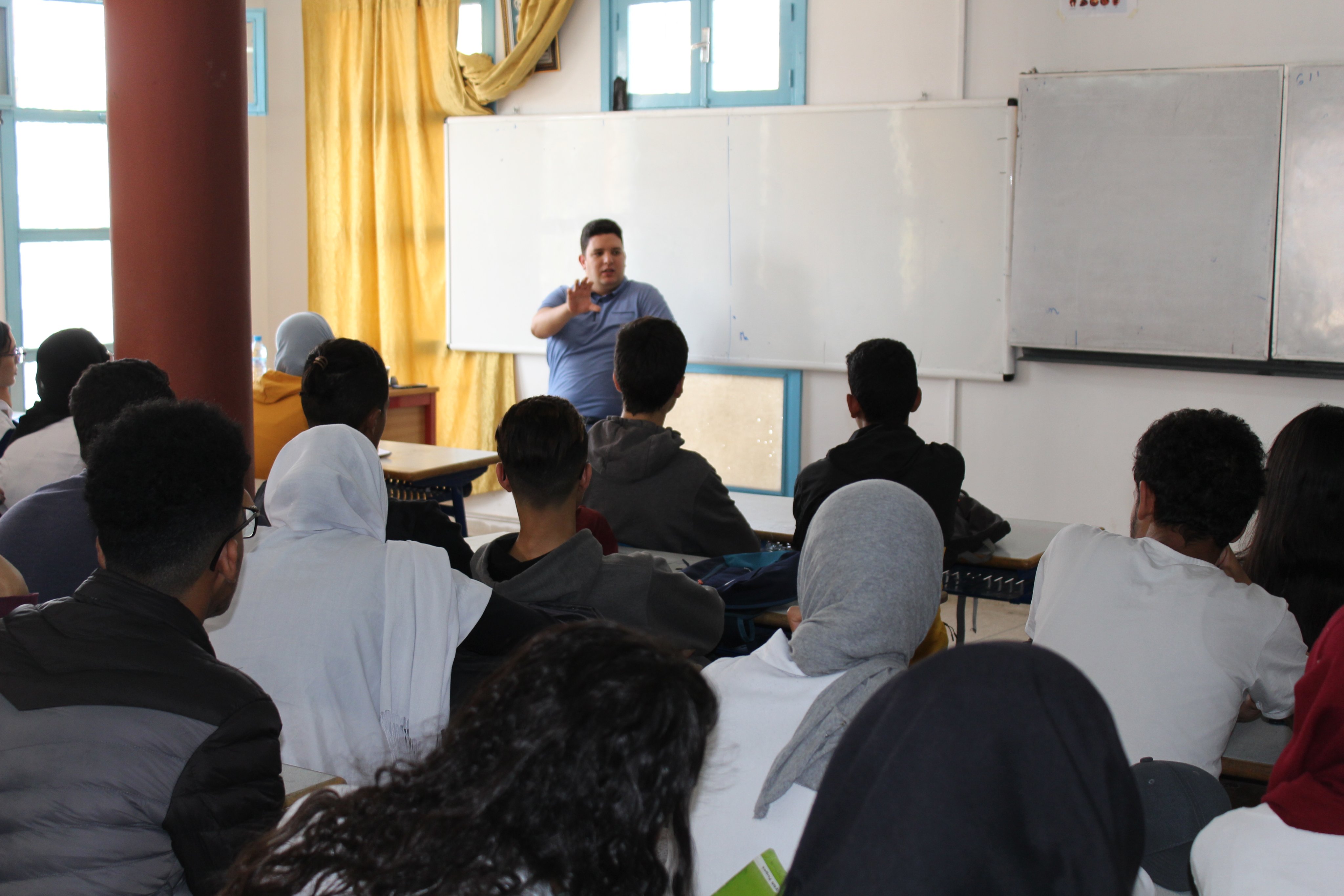
The last week of the month was however the busiest. On Tuesday the 25th, we had Mr.Adam Bouhadma, the CEO of the educational platform 9rayti.com, hosted in Ibn Maja high school, an institution with which we coordinate to activate both our Rise program for this term and their environmental club. During his visit, Mr.Bouhadma answered some students’ inquiries on studying to achieve their personal and professional goals. This session was particularly interesting for the IT enthusiasts.
Image

Two days later, a former intern in Dar Si Hmad, and one of the Environmental Youth Ambassadors, came back to the organization, this time as a member of 3W Academy to lead a programming workshop that benefited more than 25 students. On the same day, we had members from the social club of the National School of Commerce and Management collect some food DSH donated for the humanitarian caravan those students were organizing. We were so happy to see them grateful for our act.
Image may contain: 2 people, people sitting

Image may contain: 7 people, people standing, shoes and outdoor

Friday after, we had our first session of Ljamae Azgzaw, our new monthly event that aims at raising people’s awareness on environmental issues especially in Agadir. In its first appearance, we had the staff of Surfrider Foundation Maroc animate a workshop on climate change and the relation between the ocean and the climate. This session has exceptionally stirred the tensions of the attendees who all felt concerned about the climate crisis.
Image may contain: 1 person, standing and indoor

Besides these high points that made of February 2020 a special month in DSH, our steady big projects still are continuously running to fulfill the number 1 aim of the organization.