Dar Si Hmad for Development, Education and Culture is an independent nonprofit organization founded in 2010 promoting local culture and sustainable initiatives through education and the integration of scientific ingenuity in Southwest Morocco. We operate North Africa's largest fog harvesting project, providing villages with access to potable water. Our Water School and Girls' E-Learning Programs build capacity in the Anti-Atlas Mountains. Through our Ethnographic Field School, researchers and students engage with local communities in Agadir, Sidi Ifni, and the rural Aït Baamrane region for meaningful cross-cultural exchange.

Thursday, April 30, 2020

The Capacity Building Program Beneficiaries: The Moroccan NGO for the Protection and Evaluation of the Moroccan Manuscripts


Among all the NGOs that benefited from Dar Si Hmad’s Capacity Building program, The Moroccan NGO for the Protection and Evaluation of the Moroccan Manuscripts is perhaps the most unique in terms of its mission and activities. To learn more, read our Q&A with Lahoucine Laghzal, who represented the organization at our get-together on December 28th.

Lahoucine Laghzal, a member of the Moroccan NGO for the Protection and Evaluation of the Moroccan Manuscripts

When was your NGO founded and what is your main area of activity?
Our NGO was first founded in 2015, but its board members were only elected in 2017.
We wear many hats in our organization: from organizing the inventory of the local Moroccan manuscripts, evaluating them, protecting them and restoring them by fixing them. Once this is done,  we can then submit them to research centers able to further preserve them.

How did you learn about Dar Si Hmad Capacity Building Program for NGOs? And why did you apply for it?
A member of our organization came across a post on the program. And we reached out, applied and were selected.

How did your organization benefit from this training?
We learned how to manage projects and have a stronger structure. We also became convinced of the importance of networking to achieve collective and common goals of preserving our traditional ways of knowledge and culture. 

What are your NGO’s new year’s resolutions for 2020?
Besides the preservation of heritage in general, we would also like to make cultural preservation an important component of development; such a field should have many job opportunities, for instance.

Do you see any future possible collaborations working with Dar Si Hmad on a project?
Indeed, especially since Dar Si Hmad works in development, which means that there is common ground on which to cooperate and unite our efforts in order to achieve goals.

Dar Si Hmad wishes encouragement and support for the very noble mission of the Moroccan NGO for the Protection and Evaluation of the Moroccan Manuscripts.

Tuesday, April 21, 2020

Water in the age of coronavirus


In the age of a pandemic, there is one piece of advice repeated again and again by health and government officials: wash your hands. Specifically, wash your hands for 20 seconds with clean water and soap.

But in Morocco – a country where water resources have fallen by 71% since 1980 – access to clean water and sanitation can be challenging, especially for those in the mountains and rural areas. It is during unprecedented times like these that we are reminded of the importance of Dar Si Hmad’s fog harvesting project: a project that captures fog and turns it into clean water for Morocco’s most vulnerable.

For residents in the Anti-Atlas mountains, close to Sidi Ifni, many have to make hours-long trek to get to and from their nearest water source. This trek is most often made by women, who are considered as providers within the household, who can only bring back so much water after a long trek. Access to clean water for those in these regions seems to be, unfortunately, a luxury.

Clean water, however, is a human right. It is a human right that can save lives during the time of a global pandemic. After all, washing your hands and limiting activity outside the home are powerful measures to prevent the contraction and/or spread of coronavirus. But practicing these preventative measures is not easy for those who must travel hours for water. In Morocco, a stay-at-home order was put in place preventing all non-essential travel outside of the house.

Despite temporarily closing our offices in Agadir, we at Dar Si Hmad are carrying on our work to make sure some of Morocco’s vulnerable communities continue having access to clean water. Most importantly, we are currently in the preparation phase for building new CoudFishers – or, fog collectors – in Taloust, an area adjacent to the Boutmezguida fog collection site. Once this construction is done, Dar Si Hmad will be able to provide 32 tons of water a day to 12 additional rural villages of Southwest Morocco.

But the work does stop here, the local communities do come together to support one another in mutual aid. That is why Dar Si Hmad has donated the support proceedings of fog-water for the entire month of March to the beneficiaries.  We continue the tradition of Si Hmad Derhem who, in dire times of need, showed amazing support for these communities. 

Even after the age of coronavirus, however, there will still be work to do. The effects of climate change – which, in Morocco, include tougher, longer and harder droughts – will cause more and more people to risk losing their access to clean water as well as their source of livelihood. Additionally, experts warn that climate change may exacerbate the frequency and spread of diseases like the coronavirus. With so much uncertainty and risk, one thing that is clear is the need for projects like Dar Si Hmad’s fog harvesting project that provide access to clean water. 


Written by: Gari De Ramos, Dar Si Hmad Intern

Thursday, April 9, 2020

Dar Si Hmad highlights of March 2020


We always keep you informed about Dar Si Hmad’s main events and actions via our social media platforms, we had to however close our offices to respond to the call “stay home,” but we continue being close to the community we service. 

We always keep you informed about Dar Si Hmad’s main events and actions via our social media platforms, we had to however close our offices to respond to the call “stay home,” but we continue being close to the community we service. 

During the same period, Dar Si Hmad had GRACE program running, Girls Read And Communicate in English reactivated after the brief stop it took when our former intern, Ambar Khawaja, completed her mission. This time, it was Gwen Whidden, a Fulbright who teaches English at the school of trade and management, the ENCG of Agadir, who volunteered to do this job. Her first meeting with the beneficiaries, students from Ibn Maja high school was indeed promising as more students expressed their interest in joining the program.

Unfortunately, both these initiatives were interrupted by the emerging pandemic Covid-19 that caused a sudden shutting of the countries’ borders. Finding plane tickets to get the Lewis and Clark students back home was a difficult moment. Dr. Leah Gilbert, their professor, our EFS manager, Perry DeMarche, and our ED worked tirelessly until they got all the students back home. In the end, even our EFS manager had also to leave back to the US given all the uncertainty in the world today; we miss Perry every day at Dar Si Hmad. 

Gwen Whidden, on the other hand, left to the US through the coordination of the US consular services. She and the other Fulbrighters were sent back home. GRACE is now on hold, but we hope, nonetheless, to be able to launch this program once more as soon as a new native English speaker joins our NGO once we resume our activities.

Finally, we had to close our offices in Agadir and carry the remaining work from home. Only few staff who work in Boutmezguida stay in the field as we are currently building an extension to the fog project. Our permaculture farm, Agdal Ibrahim IdAachour, needs to be maintained as well where staff continues to care for the plants. All other programs are presently on hold but we hope everything will soon resume after all of us have taken this moment to reflect on what this pandemic means for our human societies.

Monday, March 30, 2020

The Capacity Building Program Beneficiaries: Atlas NGO for Development and Social Cooperation


This past December 2019, Dar Si Hmad organized a get-together for all the participating NGOs of the Capacity Building program, launched in October 2018, and that Dar Si Hmad ran for 10 months.

Although the meeting focused on the achievements of the organizations since the end of the training, and also future possible collaborations amongst the NGOs, we also wanted to give the organizations the opportunity to present their work to Dar Si Hmad’s followers.

Boujemaa Ben Haya, a member of Atlas NGO for Development and Social Cooperation.

The answers below are the responses from Boujemaa Ben Haya, a member of Atlas NGO for Development and Social Cooperation.

 When was your NGO founded and what is your main area of activity?

Our NGO was founded in 2000. And it has since then been working on development. We work to make multiple cultural, educational and sports projects successful.

How did you learn about Dar Si Hmad Capacity Building Program for NGOs? And why did you apply for it?

We learned about it through social media and we immediately applied for it because we desperately wanted to grow and empower our organization. We also knew that this program would be an ideal opportunity to talk about our experiences with the other participating NGOs.

How did your organization benefit from this training?

The training sessions taught us important skills and techniques that we have applied to our organization’s management, they have been impactful. And once again, having the chance to meet all these committed people from different NGOs and exchange with them also benefited us enormously.

What are your NGO’s new year’s resolutions for 2020?

Since its founding, the organization has worked on important development projects. And as part of its annual program for 2020, big goals were set in development, social, and educational fields. The first one is our road paving project and our project of providing drinking water to the communities we serve. We also are planning educational and recreational programs to benefit school students.

Do you see any future possible collaborations working with Dar Si Hmad on a project?

Considering that Dar Si Hmad is a pioneer in terms of creating partnerships with global non-governmental organizations, we hope that we will have the opportunity to partner with them too to gain support for our organization's projects.

Atlas NGO for Development and Social Cooperation is one of our beneficiaries that showed dedication and improved the services they offer in their region. We are so proud to learn that our Capacity Building program helped them empower their organization even more.

Wednesday, March 18, 2020

Dar Si Hmad highlights of February 2020


As Dar Si Hmad spent last January laying the foundation for many exciting projects for this year, February was marked by the bustling movement in and out of the office.


Below are some of the highlights of February 2020:


On February the 3rd, three professors from Quinnipiac university joined Dar Si Hmad as part of our Ethnographic Field School. Their visit was filled with informative stops. From exploring the staggering Cité de l’innovation and understanding the agriculture and water issue relation at the APEFEL, to feasting on organic food that has grown in a permaculture farm that surged in the middle of Guelmim desert, to finally hiking to our fog harvesting site and witnessing water production from fog.

Image may contain: 3 people, people standing

Right after their departure, our executive director and EFS manager moved to Marrakech in order to meet with a group of students from Lewis & Clark college and guide them around CIPA, the crossroad of agro-ecological initiatives and practices, in the suburbs of the city. These students are presently with us, to fulfill a part of their study-abroad program.
Image may contain: one or more people, people standing, mountain, sky, child, outdoor and nature

The next highlight of last February was the visit of three young explorers to our office. With an aim of promoting scientific research in the field of sustainable development, they had Dar Si Hmad fog project documented, before heading to Domaine Nzaha for permaculture near Guelmim, that also worked its magic on them.
Image may contain: 1 person, sitting, table and indoor

The following visit to our office was of a group of students from the SIT, School for International Training in Rabat. Their Stop in Dar Si Hmad gave them the opportunity to hear about the harvesting fog project and also to meet our Ethnographic Field School manager, Ms.Perry Demarche, who is an alum of the same Journalism and New Media SIT program.
Image may contain: 14 people, people standing and indoor

The following day, the 21st of February, Ms.Khadija Benhami, the head of the partnerships and cooperations department in the Provincial Delegation of Education in Agadir, came in the company of a teacher and the principles of two schools that are prominent for the environmental education they give. Many common issues were tackled during the meeting we had, and a more active cooperation was programmed for the future.
Image may contain: 7 people, people standing and indoor

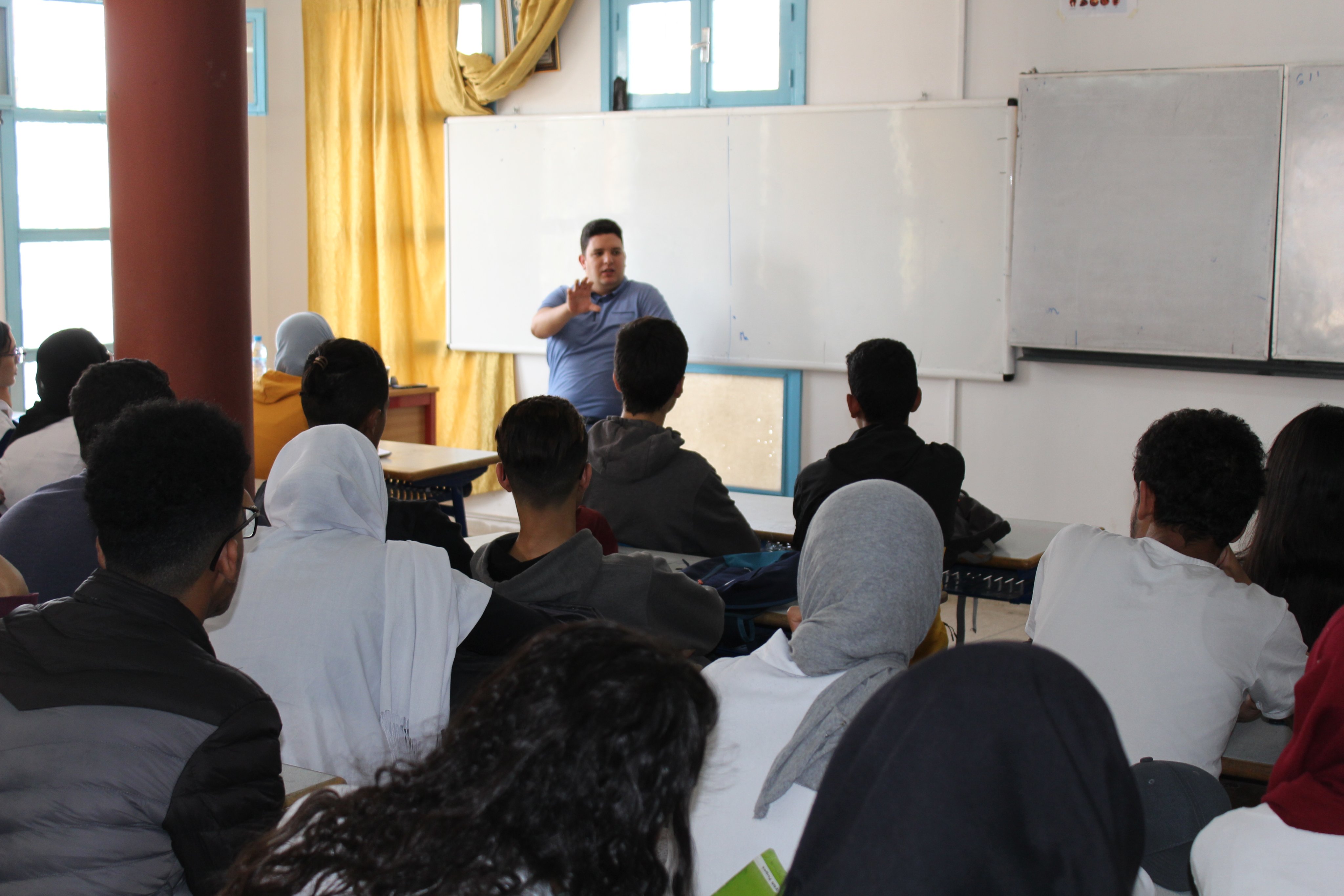
The last week of the month was however the busiest. On Tuesday the 25th, we had Mr.Adam Bouhadma, the CEO of the educational platform 9rayti.com, hosted in Ibn Maja high school, an institution with which we coordinate to activate both our Rise program for this term and their environmental club. During his visit, Mr.Bouhadma answered some students’ inquiries on studying to achieve their personal and professional goals. This session was particularly interesting for the IT enthusiasts.
Image

Two days later, a former intern in Dar Si Hmad, and one of the Environmental Youth Ambassadors, came back to the organization, this time as a member of 3W Academy to lead a programming workshop that benefited more than 25 students. On the same day, we had members from the social club of the National School of Commerce and Management collect some food DSH donated for the humanitarian caravan those students were organizing. We were so happy to see them grateful for our act.
Image may contain: 2 people, people sitting

Image may contain: 7 people, people standing, shoes and outdoor

Friday after, we had our first session of Ljamae Azgzaw, our new monthly event that aims at raising people’s awareness on environmental issues especially in Agadir. In its first appearance, we had the staff of Surfrider Foundation Maroc animate a workshop on climate change and the relation between the ocean and the climate. This session has exceptionally stirred the tensions of the attendees who all felt concerned about the climate crisis.
Image may contain: 1 person, standing and indoor

Besides these high points that made of February 2020 a special month in DSH, our steady big projects still are continuously running to fulfill the number 1 aim of the organization.

Saturday, February 29, 2020

The Capacity Building Program Beneficiaries: FIKR NGO

On December 28TH 2019, Dar Si Hmad organized a get- together for the organsations and association which  benefited from our Capacity Building program. This initiative provided training and guidance for NGOs in Southwest Morocco. Marouane Ijioui and Hassan Idouhan from the Ifni-based association FIKR attended the event and answered some of our questions, giving you insights on how their NGO functions
Marouane Ijioui, the president of Fikr NGO
Below is a translation of our discussion:

Q: When was your NGO founded and what is your main area of activity?

A: Fikr was founded in 2013 and it works mainly in Cultural activities.

Q: How did you learn about Dar Si Hmad’s Capacity Building Program for NGOs? And why did you apply for it?

A: We learned about it through a friend and for us, it was an opportunity since we knew that the training was meant to empower NGOs active in different fields, including culture –which was what was relevant to us.

Q: How did your organization benefit from this training?

A:  This training taught us a lot and made several concepts become very clear for us.  All this in the end helped us tremendously in becoming a very active NGO in the province of Sidi Ifni.

Q: What are your NGO’s new year’s resolutions for 2020?

A:  We aim to attain two main goals: Revitalizing the cultural scene of Sidi Ifni and empowering future leaders.

Q: Do you see any future possible collaborations working with Dar Si Hmad on a project?

A: Of course! After all, we both work within the field of Culture and in Sidi Ifni which makes a collaboration between our organizations a very likely event.

Dar Si Hmad was delighted to see  Marouane and Hassan again at this get-together – they even showed us a video summarizing all the amazing work they’ve accomplished since the Capacity Building program. 

Friday, February 14, 2020

Dar Si Hmad Highlights of January 2020


Dar Si Hmad kicked off 2020 with the return of our Executive Director, Jamila Bargach, from the Oak Institute of Human Rights at Colby College. Energized by her return, Dar Si Hmad has already had a busy start to the new year and has laid the foundation for many exciting projects for the upcoming months.

Here are some highlights from this past month:


  • Dar Si Hmad was nominated for the « Terre De Femmes» prize from the Yves Rocher Foundation. The prize recognizes the achievements of women in promoting biodiversity efforts. This month, representatives from the Foundation came to learn about and film our work in both Agadir and Ifni. 
  • We are currently working on connecting a 16th village to the fog water system. This month we achieved several milestones with the procedural work that is necessary for extending the project and providing the Taloust Valley with fog water. 
  • With our educational programs, we ran hands-on lessons on permaculture both in Agadir high schools and in schools near our fog project in Aït Baamrane. These programs encouraged students to reflect on their own consumption habits and the environmental impact of these habits. 
  • We hosted many specialists and consultants at our pedagogical permaculture farm. These specialists helped us develop long-term plans for our farm and specifically discussed strategies for restoring the top soil. 
  • On January 13th, Dar Si Hmad participated in a celebration of the new Amazigh new year (2970), organized by students from Ibn Zohr University. As part of this event, we held an art exposition featuring paintings from our Rhizomes Arts Artistic Residency that took place last September. 
  • Finally, we are in the process of preparing for our 2020 Ethnographic Field School programs. We will be hosting a group of professors from Quinnipiac University in February, and a group from Lewis and Clark University this March. Our Executive Director and Ethnographic Field School Manager have already visited a permaculture farm with the Lewis and Clark students as part of their Marrakech-based program, and the students will soon be joining us for a full program in Ifni and Agadir!
Dar Si Hmad has kicked of 2020 with many projects, and we are excited to see what else is in store for the new year! Stay tuned for our annual report recapping all of 2019.